
The Expert Feedback Problem
Why too much advice can make a founder less fundable

Dear Readers,
Welcome to the latest edition of the HealthVC newsletter.
HealthVC is the go-to newsletter for founders, LPs, and emerging managers who want to master fundraising, build institutional-grade data rooms, and understand how investors actually make decisions.
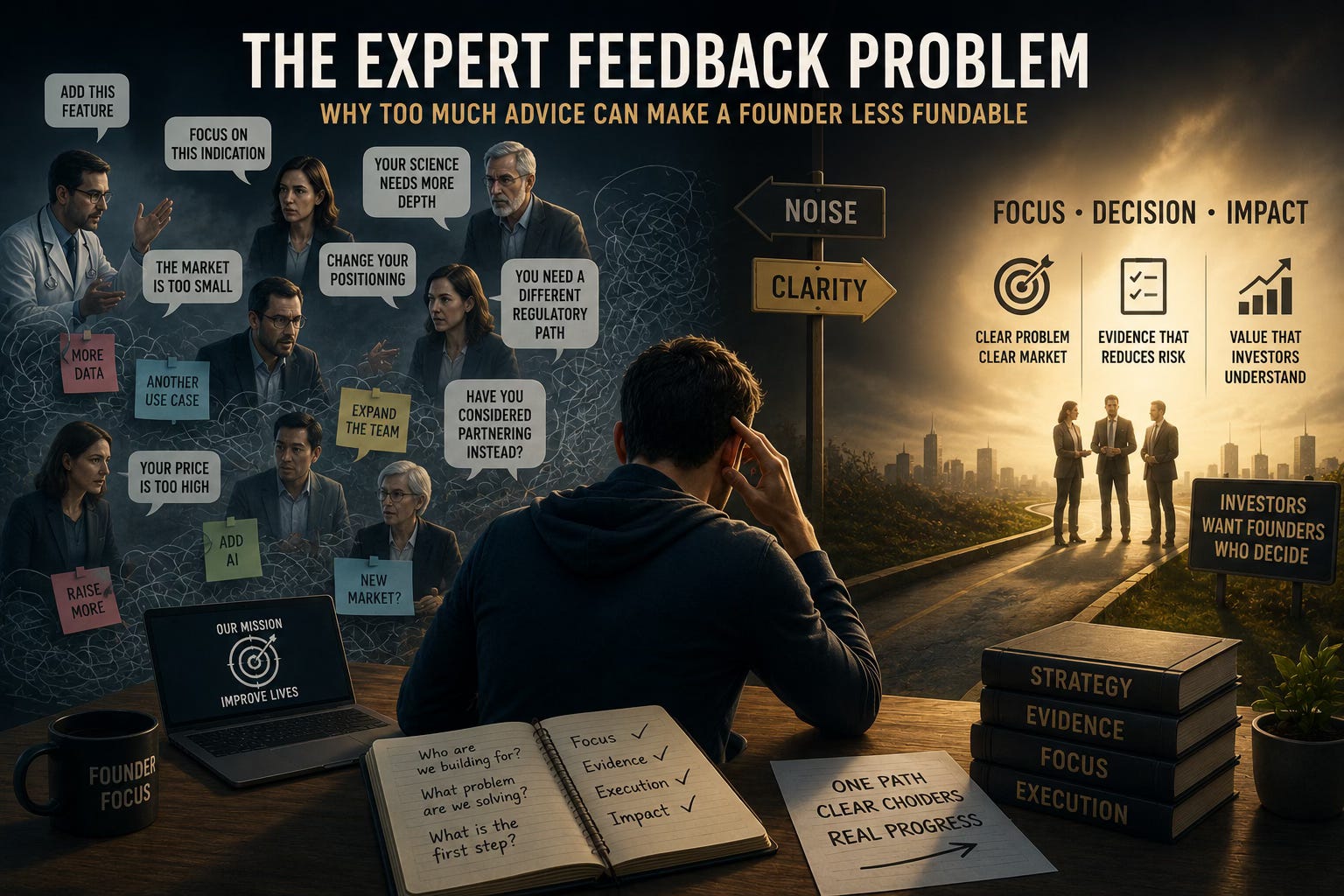
One of the most confusing parts of building a health company is that almost everyone has an opinion. Advisors have opinions. Clinicians have opinions. Professors have opinions. Investors have opinions. Operators have opinions. Consultants have opinions. Strategic partners have opinions. Mentors, accelerators, grant reviewers, hospital contacts, pharma scouts, regulatory experts, and fellow founders all have opinions.
At the beginning, this feels useful. The founder wants to learn, and the company is still forming. Every conversation seems to reveal something important. A clinician explains the workflow. A professor challenges the science. An investor questions the market. An operator points out a commercial risk. A consultant suggests a regulatory route. An advisor recommends a different use case. A hospital contact says the product needs another feature. Someone else says the company should focus on a completely different buyer.
The founder leaves each conversation with more information, but not always more clarity.
This is the expert feedback problem. Health founders are surrounded by smart people, but smart feedback does not automatically become a good strategy. In fact, too much expert feedback can make a company slower, more confused, and less decisive if the founder does not know which feedback actually matters.
The danger is not that experts are wrong. Many of them are genuinely helpful. The danger is that their advice is shaped by their own context, incentives, experience, risk tolerance, and view of the market. A clinician will usually see the company through the clinical workflow. A professor may see it through scientific validity. An investor may see it through fundability. A regulatory consultant may see it through compliance risk. A commercial operator may see it through selling difficulty. A strategic partner may see it through their own corporate priorities.
Each perspective can be useful. None of them is the whole truth.
The founder’s job is not to collect as much advice as possible. The founder’s job is to decide which advice should change the company.
More feedback does not always create more clarity
There is a point where feedback stops helping and starts creating noise. Most founders do not notice this immediately because advice feels productive. The founder is taking meetings, learning from experienced people, validating assumptions, and building a network around the company. It can feel like progress, especially in health, where credibility matters and access to experts is often hard to earn.
But feedback can become a substitute for decision-making. Instead of choosing a first market, the founder keeps asking more people what they think. Instead of committing to a regulatory pathway, the founder keeps collecting opinions. Instead of testing pricing directly with buyers, the founder asks advisors whether the price feels reasonable. Instead of narrowing the use case, the founder adds more possibilities because each expert sees another opportunity.
This is how a company becomes heavier without becoming sharper.
The deck starts to change after every conversation. The product roadmap becomes crowded with features suggested by people who may never buy the product. The market narrative becomes broader because each expert sees a different application. The founder starts using phrases like “we have had very positive feedback from experts,” but struggles to explain what that feedback has actually proven.
Investors can feel this quickly. A founder who has absorbed too many opinions without filtering them often sounds less clear, not more clear. The company becomes difficult to understand because it is carrying the fingerprints of too many outside voices. The problem, customer, use case, evidence plan, regulatory logic, and commercial strategy all start to blur.
This is why more feedback does not always make a company more fundable. Fundability usually improves when the founder becomes clearer, not when the company becomes more crowded with perspectives.
Experts give advice from where they stand
One of the most important things founders need to understand is that expert feedback is never neutral. It may be thoughtful, experienced, and well-intentioned, but it still comes from a specific position. The expert is seeing the company through the lens of their own world.
A clinician may focus on whether the product fits real patient care, but they may not understand how the hospital will buy it. A professor may focus on scientific depth, but they may not understand what level of proof is needed for venture financing. A regulatory expert may focus on the safest pathway, but that path may not always match the company’s capital constraints. An investor may push for a sharper market narrative, but they may not fully understand the clinical complexity. A strategic partner may suggest a direction that is useful for their company, but not necessarily for the startup.
This does not mean the advice is bad. It means the founder has to interpret it properly.
The same piece of feedback can be valuable or dangerous depending on how it is used. If a clinician says the product needs a new feature, that may reveal a real workflow barrier. It may also reflect one institution’s preference. If an investor says the market is too narrow, that may mean the company needs to explain the expansion path better. It may also mean that the investor is not the right fit for the category. If a professor says the science needs more depth, that may be true for publication, but not necessarily for the next financing milestone.
Founders get into trouble when they treat all expert feedback as equally important. They start reacting to the status of the person giving the advice rather than the relevance of the advice itself. A well-known professor says something, so the company changes direction. A senior investor challenges the story, so the founder rewrites the whole narrative. A respected clinician asks for a feature, so it goes on the roadmap.
That is not a strategy. That is outsourcing judgment.
Advice can hide uncertainty
Sometimes founders keep collecting feedback because they are avoiding the discomfort of making a decision. This is common in health because decisions are expensive. Choosing the first indication, first use case, first customer segment, first product boundary, first evidence package, or first regulatory path can feel scary. Once the founder chooses, other possibilities must be delayed or ignored.
Expert feedback gives the founder permission to keep the decision open. There is always one more person to ask, one more advisor to consult, one more investor to speak with, one more clinician to interview, one more regulatory view to compare. The company appears to be learning, but in reality, it may be postponing commitment.
Investors are sensitive to this because venture-backed companies need decision-making discipline. They do not expect founders to know everything, but they do expect them to make hard choices with incomplete information. A founder who cannot filter advice may struggle when the company needs to move quickly, allocate capital, prioritise milestones, hire the right people, or say no to distracting opportunities.
This is where too much advice can make a founder less fundable. It can signal that the founder does not yet have the confidence or clarity to lead the company through uncertainty. The founder may be surrounded by impressive advisors, but if every external opinion changes the company’s direction, investors will worry that the business has no internal centre of gravity.
The strongest founders listen widely but decide narrowly. They gather input, understand the pattern, separate signal from noise, and then make a clear choice. They do not need every expert to agree before they act. They need enough evidence to move forward intelligently.
The advisor problem
Health startups often build advisory boards early because credibility matters. A strong advisory board can help a company access clinical insight, regulatory understanding, scientific validation, market knowledge, investor confidence, and strategic relationships. Good advisors can save founders from expensive mistakes.
But advisory boards can also become a hiding place.
Some founders use advisors to signal credibility before the company has enough evidence. The deck becomes full of impressive names, but the business itself is still unclear. Other founders confuse having advisors with having execution capability. They assume that because the company has access to senior experts, it has solved the knowledge gap. Investors know the difference.
An advisor is not a strategy. An advisor is not a buyer. An advisor is not a management team. An advisor is not proof that the company can execute.
The real question is what the advisor actually changes. Are they helping the company make better decisions? Are they opening the right doors? Are they pressure-testing the evidence plan? Are they helping the founder understand the market? Are they reducing a real risk? Are they engaged enough to matter, or are they mostly a name on a slide?
Founders should be honest about this. A small number of deeply useful advisors is often more valuable than a long list of impressive but passive names. Investors care less about how many experts are attached to the company and more about whether the founder knows how to use expertise properly.
The best advisors make the company sharper. Weak advisory structures make the company look decorated, but not stronger.
The danger of building by committee
The expert feedback problem becomes most damaging when the company starts building by committee. This happens when the product, market, evidence plan, and narrative are shaped by too many external opinions without a clear founder-led strategy holding them together.
The product becomes a collection of requests. The pitch becomes a collection of investor comments. The clinical plan becomes a collection of advisor preferences. The market strategy becomes a collection of possible use cases. The result is a company that tries to satisfy everyone and ends up convincing no one.
This is especially dangerous in health because complexity is already high. A health company may already need to manage scientific risk, regulatory risk, clinical risk, reimbursement risk, data risk, adoption risk, and financing risk. If the founder adds too many competing opinions on top of that complexity, the company becomes harder to understand and harder to fund.
Investors do not want a company that has been shaped by consensus from every expert who has touched it. They want a founder who can explain why the company is making the choices it is making. They want to hear the logic behind the first market, the product scope, the evidence plan, the regulatory approach, the hiring sequence, and the financing milestone. They want to know that the founder is listening, but also leading.
This distinction is important. Being coachable does not mean being directionless. Listening to feedback does not mean changing the company after every conversation. A founder can be humble and decisive at the same time. In fact, that combination is often what investors are looking for.
How to filter expert feedback
The best founders do not ask whether feedback is smart. They ask whether it is relevant to the decision in front of them. This is a different question. Smart people can give advice that is not useful for the current stage of the company. An expert may be right in general, but wrong for the milestone the company is trying to reach now.
The founder should first ask what type of decision the feedback relates to. Is it about clinical workflow, scientific validity, market demand, regulatory pathway, reimbursement, pricing, product usability, fundraising narrative, or strategic positioning? Once the founder understands the category, they can decide whether the person giving the feedback has the right context to influence that decision.
The founder should also ask whether the feedback is a pattern or an isolated opinion. If one clinician asks for a feature, that may be interesting. If ten clinicians across different institutions identify the same workflow barrier, that is more important. If one investor dislikes the market, that may reflect fund fit. If multiple relevant investors struggle with the same part of the story, the founder should pay attention. If one advisor suggests a new application, that may be optionality. If several market participants point to the same urgent use case, that may be a strategy.
Context matters. Pattern matters. Relevance matters.
The founder also needs to separate feedback that improves the company from feedback that merely expands the company. Some advice creates focus. Some advice creates more work. Some advice reduces risk. Some advice adds complexity. Some advice makes the investment story clearer. Some advice makes the company sound bigger but harder to underwrite.
The strongest founders are disciplined about this. They do not accept advice just because it sounds intelligent. They ask whether it helps the company become more focused, more credible, more fundable, or more valuable.