
The Fake Traction Problem
Why founder excitement often looks stronger than investor evidence

Dear Readers,
Welcome to the latest edition of the HealthVC newsletter.
HealthVC is the go-to newsletter for founders, LPs, and emerging managers who want to master fundraising, build institutional-grade data rooms, and understand how investors actually make decisions.
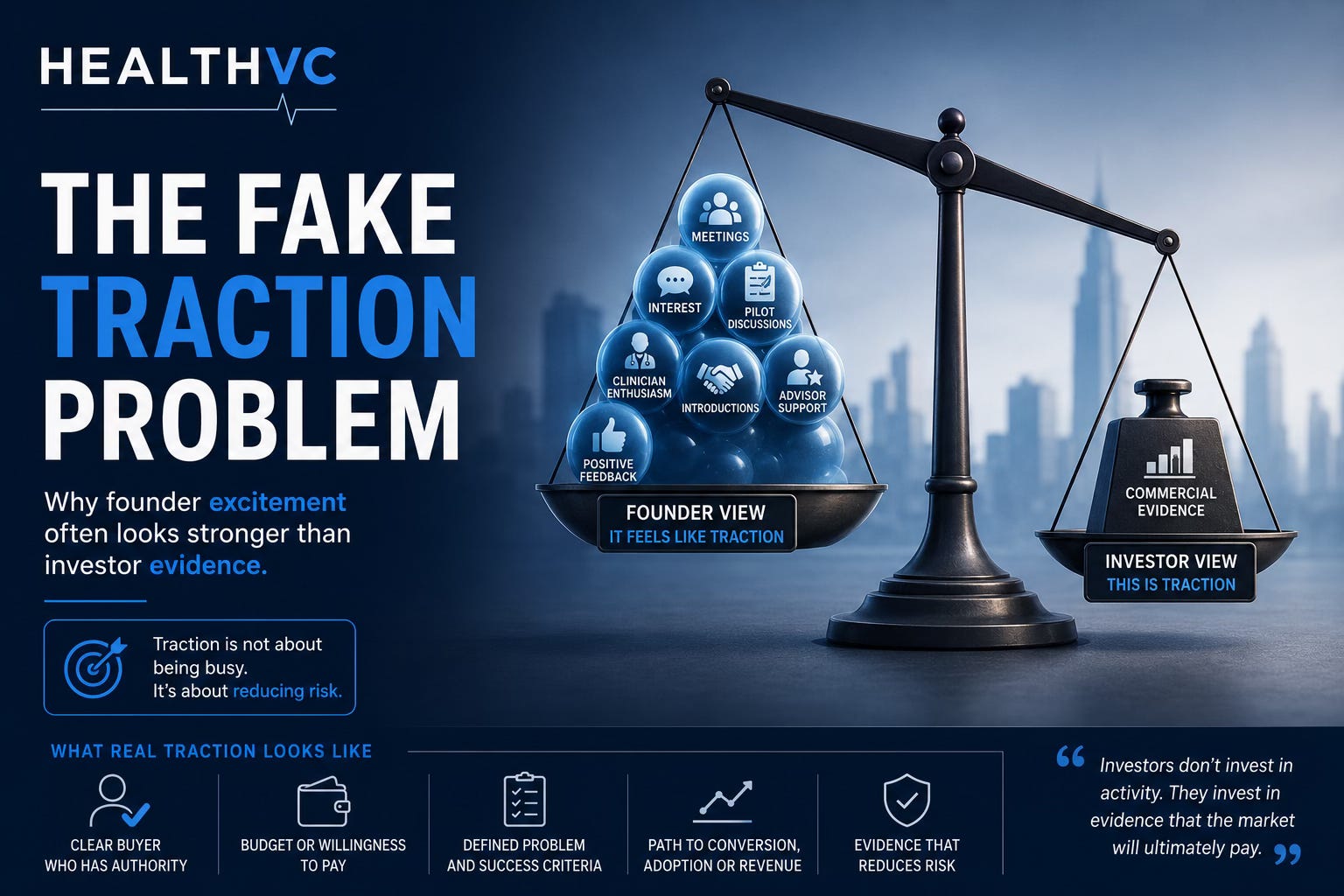
One of the most dangerous moments in fundraising is when a founder starts to believe their own traction before the market has fully validated it. This happens more often than most founders realise, especially in health, where early signals can feel incredibly promising long before they become commercially meaningful. A hospital agrees to a conversation. A clinician says the product is needed. A pharma company asks to learn more. A strategic partner says the technology is interesting. A potential customer gives positive feedback. A pilot is being discussed. An advisor introduces the company to a senior contact. An investor says the market is exciting. From the inside, all of this can feel like movement.
The problem is that investors do not evaluate these signals in the same way founders do. Founders often see early interest as proof that the company is working. Investors ask a much harder question. They want to know whether that interest reduces risk. They want to know whether it moves the company closer to adoption, revenue, reimbursement, procurement, clinical validation, regulatory progress, repeat usage, strategic commitment, or a stronger next round. That difference matters because fundraising is not won by proving that people are curious. It is won by proving that the company is becoming more investable.
This is the fake traction problem. It is not usually caused by dishonesty. Most founders are not trying to mislead investors. The problem is more subtle. Founders spend months trying to get the market to care, so when the market finally responds with meetings, feedback, pilots, introductions, and supportive comments, those signals can feel much stronger than they really are. The founder has been pushing against silence for so long that any positive signal feels like evidence. But not every positive signal is traction. Some signals are useful learning. Some are relationship building. Some are early validation. Some are polite curiosity. Some are genuine steps toward commercial proof. Investors are trying to separate those categories quickly.
That is why fake traction is so dangerous. It can get a founder into investor conversations, but it often cannot carry the founder through diligence. At the top of the funnel, traction can sound impressive when it is described in broad terms. Investors may respond well to a deck that mentions pilots, partners, clinical enthusiasm, inbound interest, strategic conversations, and institutional logos. But once diligence starts, the quality of that traction gets tested. The investor asks who owns the pilot, whether it is paid, whether there is a budget, whether there are success criteria, whether there is a path to conversion, whether the customer has urgency, and whether the relationship is connected to a real buying process. That is where weak traction starts to lose its shape.
Interest is not the same as traction
The first form of fake traction is interest. Interest feels good because it creates energy. Someone takes the meeting. Someone replies to the email. Someone says the product could be useful. Someone says the problem is real. Someone says the founder should keep them updated. Someone introduces the company to another stakeholder. For an early-stage founder, this can feel like the beginning of market pull, especially if the company has struggled to get attention before.
But interest is cheap compared with adoption. It does not require a budget. It does not require procurement. It does not require a workflow change. It does not require legal review. It does not require integration. It does not require internal risk. It does not require a customer to change behaviour. This is why investors discount interest heavily. They do not ignore it completely, because interest can be useful at the earliest stage, but they rarely treat it as strong evidence unless it is connected to something more concrete.
This matters even more in health because many people can be interested without being buyers. Clinicians may care deeply about the problem, but they may not control the budget. Hospital innovation teams may enjoy exploring new solutions, but they may not be able to move a product through procurement. Pharma teams may take early meetings because they are scanning the market, not because they are ready to commit resources. Advisors may be enthusiastic because the science is interesting, but they may not represent real market demand. Patient groups may validate the importance of the problem, but that does not always translate into a scalable business model.
Founders need to be careful with the language they use around interest. Saying “hospitals are interested” is much weaker than saying a specific department has identified a workflow problem, a budget owner has been engaged, and a paid pilot is being structured around defined success criteria. Saying “pharma is interested” is much weaker than saying a partner has identified a specific use case, committed internal resources, and agreed to a defined next step that could lead to a paid collaboration. The difference is not just wording. It is the difference between market noise and market evidence.
Pilots are not always proof
Pilots are one of the most misunderstood forms of traction in health. Many founders treat a pilot as validation because it feels hard to secure. There are meetings, documents, stakeholder calls, onboarding discussions, technical questions, clinical workflows, compliance reviews, and internal coordination. By the time a pilot is agreed, the founder may feel they have achieved something significant. In some cases, they have. But investors know that not all pilots are equal.
A strong pilot has a clear owner, a real problem, defined success criteria, an implementation plan, internal accountability, and a path to conversion if the pilot works. It is not just a trial of the product. It is a structured test of whether the company can create value for a customer in a way that could lead to adoption or revenue. A weak pilot, by contrast, may be an interesting experiment with no budget, no buyer, no urgency, no success threshold, and no commercial next step. It may look impressive in the deck, especially if the logo is strong, but it may not reduce much investor risk.
This is where founders often overvalue the wrong thing. They think the logo is the traction. Investors ask what the logo actually means. Is the pilot paid or unpaid? Who initiated it? Who owns it internally? What problem is being solved? What needs to happen for the pilot to convert? What budget would pay for the product after the pilot? Who has the authority to expand it? What happens if the pilot is successful? What happens if the pilot is neutral? How long does it take to move from pilot to contract? These questions are not designed to make the founder uncomfortable. They are designed to understand whether the pilot is evidence or theatre.
A pilot with no path to conversion may still be useful. It can help the founder learn, refine the product, understand workflows, collect feedback, validate assumptions, and build credibility. But it should not be described as commercial traction if it has not yet shown commercial intent. Investors can accept early learning. What creates concern is when founders describe learning as if it is proof.
Borrowed credibility can backfire
Another version of fake traction is borrowed credibility. This happens when a founder uses the names of large organisations, advisors, hospitals, universities, pharma companies, corporates, or investors to create the impression of momentum. The deck says the company is working with a leading hospital. It says there is interest from global pharma. It says the company is supported by senior advisors. It says conversations are ongoing with strategic partners. It says the founder has spoken with top-tier investors.
Some of this may be true, but investors want to understand what the relationship actually means. A conversation is not a partnership. An advisor is not a buyer. A hospital contact is not a procurement pathway. A pharma introduction is not a commercial agreement. An investor meeting is not investor demand. The name may open the door, but it does not automatically prove the company is moving through the market.
Borrowed credibility can help a founder get attention, but it can also weaken trust if the substance behind it is thin. Sophisticated investors have seen many early-stage companies surround themselves with impressive names before they have real evidence. They know that logos can create the illusion of progress. The issue is not whether the relationship exists. The issue is whether the relationship changes the evidence base of the company.
If a hospital is helping define workflow requirements, that matters. If a clinician is actively championing adoption inside an institution, that matters. If a strategic partner is committing resources, data, distribution, validation, or commercial access, that matters. If an advisor is materially helping with regulatory, clinical, reimbursement, or commercial execution, that matters. But if the relationship is mainly reputational, investors will treat it as weak evidence. The best founders do not inflate credibility. They explain what each relationship actually proves.
Activity is not the same as evidence
A founder can be extremely busy and still have very little investable traction. This is one of the hardest truths in early-stage company building because activity feels like progress from the inside. The calendar may be full. The pipeline may look active. There may be dozens of customer conversations, investor calls, advisor meetings, pilot discussions, conference introductions, and follow-up emails. The founder may genuinely be working hard and moving fast.
But investors are not underwriting the effort. They are underwriting the evidence. The activity shows that the founder is working. Evidence shows that the market is responding in a way that matters. A founder may have thirty customer conversations, but if those conversations have not revealed a clear buyer, budget, urgency, workflow pain, adoption path, or willingness to pay, they may not mean very much. A founder may have five pilot discussions, but if none of them have success criteria or a conversion path, the investor will remain cautious. A founder may have positive feedback from clinicians, but if the buyer is a hospital CFO, procurement lead, payer, employer, pharma team, or department head, clinical enthusiasm alone will not prove commercial demand.
This is where founders need to become more disciplined in how they interpret momentum. The question is not whether something happened. The question is whether it reduced a specific risk. Did the conversation clarify the buyer? Did the pilot test a real implementation barrier? Did the feedback confirm urgency? Did the partner discussion reveal a commercial use case? Did the customer engagement show willingness to pay? Did the clinical interaction demonstrate that the product could fit into real workflows? If the answer is yes, the signal may be useful. If the answer is no, the signal may still be positive, but it should not be overstated.
Why fake traction is especially dangerous in health
Fake traction is a problem in every sector, but it is especially dangerous in health because the distance between interest and adoption is often much longer. In many software markets, a user can discover a product, try it, buy it, expand usage, and create revenue relatively quickly. In health, the person who feels the pain may not be the person who pays. The person who loves the product may not be the person who approves the purchase. The person who uses the solution may not control the budget. The person who controls the budget may not understand the clinical urgency. The person who supports innovation may not have procurement authority.
This creates a dangerous illusion for founders. They can receive genuine enthusiasm from the wrong stakeholder and mistake that enthusiasm for commercial validation. A doctor may say the product is needed. A researcher may say the science is exciting. A hospital innovation team may say the concept is promising. A pharma scout may say the platform is interesting. A patient group may say the problem is important. All of those things can be true, and all of them can still fall short of proving a scalable business.
Health founders need to understand the difference between stakeholder validation and commercial validation. Stakeholder validation tells you that the problem matters. Commercial validation tells you that someone has the authority, urgency, budget, and willingness to act. Stakeholder validation is useful, especially early, because it helps founders understand pain, workflows, unmet needs, clinical relevance, and adoption barriers. But commercial validation is what starts to reduce the risk that the company can become a business.
This distinction is even more important when founders are fundraising. Investors know that health markets are complex. They know that adoption can be slow, procurement can be painful, reimbursement can be uncertain, and evidence requirements can be high. That means they are not easily impressed by vague signs of interest. They want to see whether the founder understands the real path from enthusiasm to implementation.
Real traction depends on the stage
Real traction does not always mean revenue. This is important because early health companies should not all be judged by the same commercial standard. A preclinical biotech company, a regulated medtech product, a diagnostics platform, and an early digital health company will all have different evidence pathways. Investors should not expect the same traction profile from each of them. But they will expect the founder to understand what kind of traction matters for their stage.
For a clinical or scientific company, real traction may be evidence that the science is moving in the right direction and that the next study can reduce a major risk. For a medtech company, real traction may involve evidence that the device solves a specific workflow problem, that the regulatory path is understood, and that early users can see measurable value. For a diagnostics company, real traction may involve analytical validation, clinical relevance, payer logic, adoption pathway, and evidence that the test changes decisions. For a digital health company, real traction may involve paid pilots, conversion from pilot to contract, usage, retention, clinical outcomes, workflow integration, and budget ownership. For a platform company, real traction may involve partner demand, data quality, repeatable use cases, scientific validation, and a credible path to monetisation.
The mistake is not being early. Investors understand early. The mistake is pretending that weak traction is stronger than it is. A founder can say, “We are still early commercially, but we have validated the workflow problem with these stakeholders and are now testing whether this can convert into a paid pilot.” That is credible. It shows discipline. It shows the founder understands the difference between learning and proof. It gives the investor confidence that the founder is not confusing positive feedback with market pull.
Precision is more investable than exaggeration. A founder who clearly explains what has been proven, what has not been proven, and what the next milestone needs to test will often build more trust than a founder who tries to make every signal sound like traction. Investors do not expect perfection. They do expect judgment.
What founders should do instead
The answer is not to remove traction from the deck or speak negatively about early progress. The answer is to describe traction with more precision. Founders should stop saying the market is excited and start explaining what the market has actually done. Who engaged? Why did they engage? What problem were they trying to solve? What level of authority did they have? Was there a budget? Was there a timeline? Was there a defined next step? Did the engagement create evidence? Did it reduce the risk? Did it move the company closer to adoption, revenue, reimbursement, validation, partnership, or repeatability?
This shift changes the quality of the fundraising conversation. Instead of saying, “We have strong interest from hospitals,” a founder can say, “We have completed discovery with five hospital departments, two have confirmed the workflow pain, one has identified a budget owner, and we are now structuring a pilot with defined success criteria around time saved and patient throughput.” That is a much stronger statement because it tells the investor what has actually been learned and what the next step means.
Instead of saying, “Pharma is interested,” a founder can say, “We have had three conversations with business development teams, but we do not yet treat this as commercial validation. The next step is to test whether the platform solves a defined partner use case that could justify a paid collaboration.” That kind of honesty may sound less impressive on the surface, but it is often more credible. It tells the investor the founder is not trying to inflate early signals. It shows that the founder understands the evidence gap and is working through it properly.
The strongest founders are not the ones who make every signal sound big. They are the ones who know how to interpret signals accurately. They understand the difference between a meeting, a champion, a pilot, a buyer, a budget, a contract, usage, retention, and repeatability. They can explain where they are in that sequence and what needs to happen next. That level of clarity is valuable because it shows commercial maturity.
What diligence really tests
The deeper issue with fake traction is that it reveals how the founder thinks about evidence. That is what investors are really testing. When a founder overstates weak traction, the concern is not only that the traction itself is weak. The concern is that the founder may not understand the difference between signal and proof.
This matters because early-stage investing is full of uncertainty. Investors know that most things are not fully proven yet. They know that founders are still testing assumptions, refining products, learning from the market, and searching for repeatability. But they need to trust that the founder can interpret reality clearly. They need to believe the founder knows what has been proven, what remains uncertain, and what needs to be tested next.
A founder who understands the difference between interest, validation, adoption, revenue, and repeatability is easier to trust. A founder who blends them together creates doubt. The way a founder describes traction tells the investor how they think about the business. It shows whether they are commercially mature. It shows whether they understand the buyer. It shows whether they know the difference between market noise and market pull.
This is why the best founders are careful with traction language. They can say, “This is early interest, not yet traction.” They can say, “This is a pilot, but not yet proof of conversion.” They can say, “This is clinical enthusiasm, but we still need to validate the buyer.” They can say, “This is a strategic conversation, but we have not yet proven partner urgency.” They can say, “This is not enough evidence yet, but this is what we are testing next.” That kind of precision builds trust because it shows the founder is not collecting vanity signals. They are building an evidence base.
Final thought
Almost every founder has some form of weak traction that they are overvaluing. That is normal. Early signals are supposed to be incomplete. They are the beginning of learning. They help founders understand the market, refine the product, test the buyer, discover urgency, and work out where adoption might come from. The problem begins when founders treat those early signals as if they have already reduced major investment risk.
Interest is useful, but it is not adoption. A pilot is useful, but it is not always commercial proof. A logo is useful, but it is not always evidence. A meeting is useful, but it is not momentum. A positive comment is useful, but it is not a buying decision. The strongest founders understand this, and because they understand it, they do not need to overstate where they are.
Credibility comes from precision. Investors do not need founders to pretend the company is further along than it is. They need founders who understand the evidence clearly enough to build the company properly. Fake traction may help a founder sound impressive for one meeting, but real traction is what survives diligence. The difference between the two is not always obvious at the beginning of a fundraising process, but it becomes very obvious once investors start asking harder questions.
That is why founders need to be honest about traction before the market forces them to be honest. The goal is not to make the company look smaller. The goal is to make the company look real. Real companies are built on evidence, not just excitement. Real investors know the difference.
P.S. Want to Stay Informed: Subscribe to HealthVC Pro, The Operating System for Founders & Emerging Managers
Stop guessing. Start executing.
HealthVC Pro gives founders, GPs, and LPs direct access to the most actionable tools in European venture capital today:
💥 A live, filterable database of 3,400+ investors, by stage, region, thesis, and type
📬 Proven outreach scripts to secure meetings with LPs, co-investors, and angels
📊 Real-world pitch decks, frameworks, and fundraising playbooks that actually work
🔍 Monthly updates to investor data, not some dusty PDF or scraped list
💬 Founding Members get async feedback on decks and messaging
Whether you’re raising your first round or deploying your third fund, this is your tactical edge.
Subscribe now and operate like a pro.
Don’t forget to check out the HealthVC on YouTube and The Terminology of Venture Capital on Amazon.
Until next time, keep venturing forward!
Every accelerator or mentor group should give this to their cohort BEFORE the program begins. It provides a vocabulary that will help startups focus from the get-go. We learned this the long, hard way. Had I read this first, our decks would have looked much different in the early days. Less hype, more specific proof . Excellent read.