
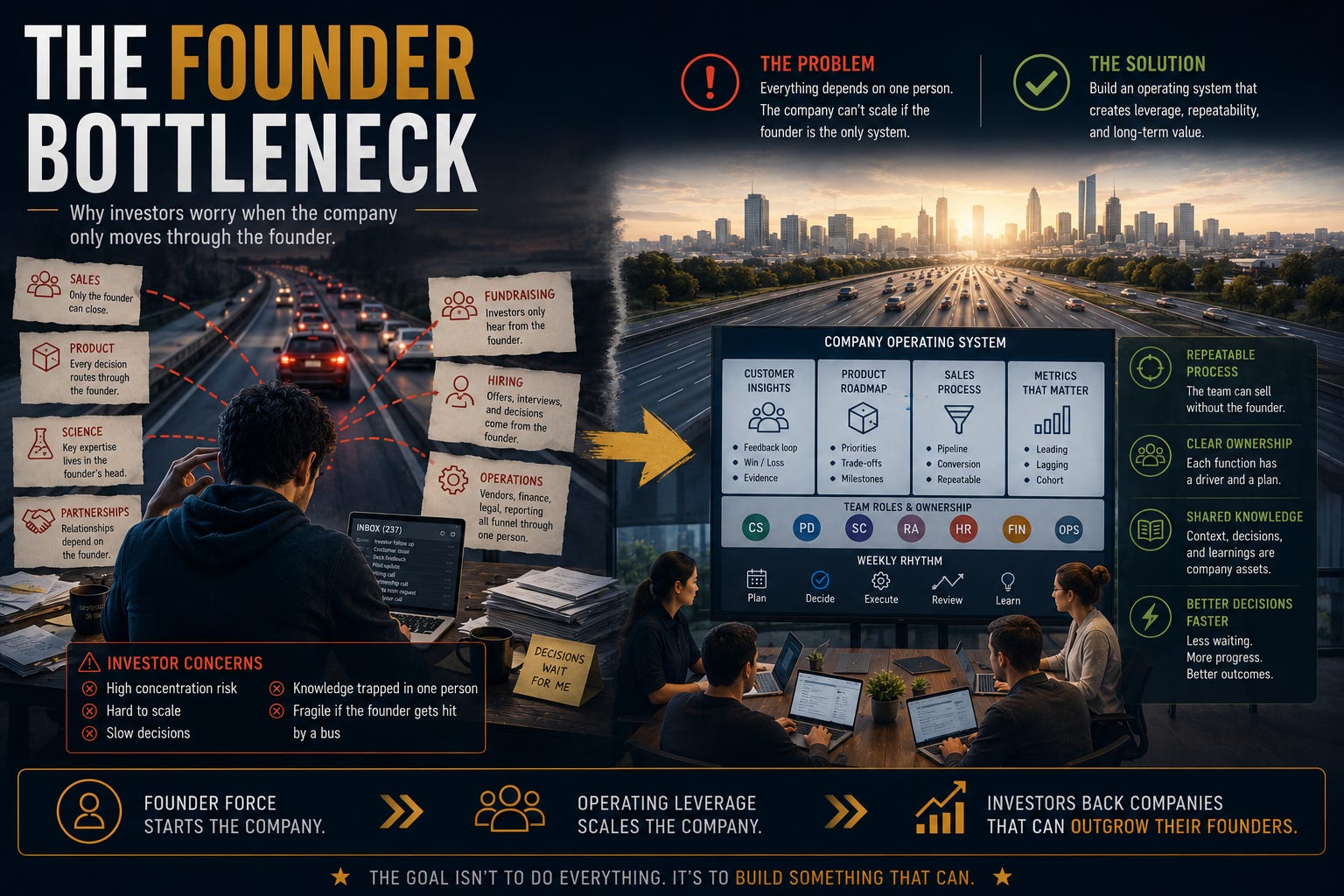
The Founder Bottleneck
Why investors worry when the company only moves through the founder

Dear Readers,
Welcome to the latest edition of the HealthVC newsletter.
HealthVC is the go-to newsletter for founders, LPs, and emerging managers who want to master fundraising, build institutional-grade data rooms, and understand how investors actually make decisions.
Every early-stage company depends on the founder. That is normal. In the beginning, the founder carries the story, sells the vision, recruits the first team, speaks to customers, manages advisors, raises capital, builds the first partnerships, shapes the product, and keeps the company moving when there is not yet enough structure around it.
Founder force is often the reason the company exists at all.
But there is a point where founder force becomes founder bottleneck.
This is one of the most important transitions in company building. At the earliest stage, investors expect the company to move through the founder. They know the founder will be personally involved in every customer conversation, investor meeting, product decision, hiring discussion, and strategic choice. But as the company develops, investors start asking a different question. Can this company begin to operate beyond the founder’s personal intensity?
That is where many early health companies get stuck. The founder is still the only person who can sell the product, explain the science, manage the pilot, speak to investors, handle partnerships, make product decisions, recruit talent, update the data room, and interpret the market. Every important decision routes through one person. Every relationship depends on one person. Every piece of momentum requires the founder to push it personally.
From the inside, this can feel like leadership.
From the outside, it can start to look like fragility.
This is the founder bottleneck. It happens when the company has no real operating system beyond the founder’s effort. The founder is busy, committed, and often impressive, but the business itself has not yet learned how to move without them touching everything.
Investors worry about this because venture capital is not only funding what the founder can do personally. It is funding whether the company can become larger, stronger, more repeatable, and more valuable over time. A company that only moves through founder force may be exciting, but it can also be difficult to scale.
Founder force gets you started
There is nothing wrong with founder force at the beginning. In fact, most companies need it. Early-stage companies do not have brand, process, reputation, systems, or institutional momentum. They have the founder’s conviction and the founder’s ability to create movement before the market gives movement back.
This is especially true in health. The first customer conversations are often founder-led because the founder can explain the nuance of the problem. The first investor meetings are founder-led because the founder can connect the story, the evidence, and the ambition. The first partnerships are often founder-led because trust is personal at the beginning. The first hires usually join because they believe in the founder’s clarity and energy.
That is expected. Investors know early companies are not mature organisations. They know the founder has to do uncomfortable things before the company has process around them. The founder may have to sell before there is a sales team, manage product before there is a product leader, discuss regulation before there is a regulatory hire, and handle fundraising while still running the company day to day.
But founder force is supposed to create the conditions for the company to become less dependent on founder force.
The danger is when the founder remains the only source of movement. If every pilot needs the founder, every customer needs the founder, every investor update needs the founder, every product tradeoff needs the founder, and every internal decision waits for the founder, the company is not becoming stronger. It is becoming more dependent.
That dependence may not look dangerous at first. The founder is often capable enough to keep things moving. But as the company grows, the number of decisions increases, the number of stakeholders increases, and the cost of founder dependency becomes harder to hide.
Investors look for repeatability
One of the things investors are trying to understand is whether early progress can repeat. A founder may be able to sell the first pilot because they are persuasive, credible, and deeply connected to the mission. But can someone else sell the second, third, and fourth? A founder may be able to hold the product together because they understand every customer conversation, but can the team make product decisions without waiting for the founder’s interpretation? A founder may be able to explain the company beautifully to investors, but can the materials, data room, and team carry the story when the founder is not in the room?
This is why founder dependency becomes an investor concern. The investor is not trying to take the founder out of the company. They are trying to understand whether the company has begun to convert founder knowledge into company capability.
There is a difference between a founder who is essential and a founder who is blocking scale. The founder should remain essential to the company’s direction, culture, judgment, and mission. But the company should not require the founder to manually push every function forward.
Investors want to see signs that the company is becoming repeatable. They want to know whether customer learning is being captured, whether sales conversations follow a pattern, whether product decisions are connected to evidence, whether hiring is filling real gaps, whether the team understands priorities, and whether the company can execute without everything becoming a founder decision.
This does not mean the company needs heavy process. Early-stage companies should not become bureaucratic. But they do need operating discipline. They need enough structure for learning, decisions, execution, and communication to compound beyond one person.
Without that, the company may look busy but not scalable.
The founder becomes the keeper of context
One of the most common signs of a founder bottleneck is that the founder becomes the keeper of all context. They remember what customers said. They remember why investors passed. They remember which advisor warned about regulatory risk. They remember why the product roadmap changed. They remember why one market was deprioritised, and another was chosen. They remember the history behind every decision.
At the beginning, this is natural. The founder is closest to the market and usually has the most complete understanding of the company. But over time, this becomes a problem if the context never leaves the founder’s head.
The team cannot make strong decisions because the reasoning behind previous decisions is not visible. New hires take longer to become effective because they are missing the market history. Advisors repeat old suggestions because they do not know what has already been tested. Investors ask for evidence, but the founder has to reconstruct the story from memory. Product discussions drift because the team does not have a shared view of what the market is teaching the company.
This creates hidden drag. Nothing appears broken immediately, but everything becomes slower. The founder has to explain more, approve more, correct more, remember more, and intervene more. The company becomes dependent on the founder not only for decisions, but for interpretation.
That is not scalable.
A company becomes stronger when founder context becomes company knowledge. Customer learning should inform the team. Investor objections should improve the fundraising story. Pilot lessons should shape product and implementation. Advisor input should be captured and filtered. Strategic choices should be documented enough that others understand why they were made.
This is how the company starts to operate beyond the founder’s memory.
Founder-led sales can hide weak sales maturity
Founder-led sales are normal at the beginning. In many health companies, they are necessary. The founder understands the problem deeply, can adapt the conversation in real time, and can build trust with early customers. In complex markets, early sales often require founder credibility.
But founder-led sales can also hide weak commercial maturity.
A founder may be able to get meetings because they are compelling, connected, or mission-driven. They may be able to create interest because they can explain the problem with intensity. They may be able to keep pilots alive because they personally follow up, solve issues, and maintain relationships. But investors will eventually ask whether this motion can scale.
If the founder is the only person who can sell, the company has not yet proven a sales motion. It has proven founder persuasion. That may be valuable, but it is not the same thing.
Investors will want to know whether the company understands the buyer, the budget, the objection patterns, the sales cycle, the implementation steps, and the conversion path. They will want to see whether the founder has turned early conversations into a repeatable process. They will want to know whether someone else could eventually follow the same logic and produce similar results.
This is especially important in health because early relationships can be highly personal. A clinician may support the company because they like the founder. A hospital may explore a pilot because the founder has built trust. A strategic partner may keep the conversation open because the founder is persistent. These are useful signals, but they are not enough unless the company can show that the relationship is becoming a repeatable commercial pattern.
The best founders use founder-led sales to learn the market, not to remain permanently at the centre of every sale.
Product decisions cannot all depend on the founder
The founder bottleneck also appears in product. Early product direction often depends heavily on the founder because the founder understands the original insight. They know the customer pain, the market gap, the scientific logic, the clinical workflow, or the technical opportunity that gave birth to the company.
But as the company grows, product decisions need to become more disciplined. If every feature, roadmap change, workflow adjustment, and implementation decision depends on the founder, the team cannot move quickly or confidently. The founder becomes the filter for everything.
This is dangerous because the founder may not always be the best product decision-maker at every stage. They may be too close to the original idea. They may overvalue certain customer conversations. They may resist narrowing the product because they see the full vision. They may add features because they want to keep every stakeholder happy. They may delay difficult tradeoffs because they personally feel the cost of saying no.
A good product process does not remove the founder’s judgment. It gives that judgment leverage. The team should understand the first wedge, the customer evidence, the adoption barriers, the success criteria, and the next milestone well enough to make decisions without waiting for the founder every time.
This matters to investors because product maturity is not only about what has been built. It is about how product decisions are made. A company that can explain why it is building one thing and not another shows focus. A company that keeps routing product through founder instinct alone may look less mature, even if the product itself is impressive.
Hiring should reduce founder dependency
Hiring is one of the clearest tests of whether a founder is building a company or simply adding people around themselves. Early hiring should reduce founder dependency. The right hire should take ownership of a real function, increase the quality of decisions, and create more leverage for the company. But many founders hire without actually letting go.
This happens for understandable reasons. The founder knows the company best. They have high standards. They worry that others will not explain the company correctly, manage customers properly, make the right product tradeoffs, or handle investors with enough care. So they hire people, but keep the real decision-making centralised.
The team grows, but the bottleneck remains.
Investors notice this. They look at the team and ask whether the company has real functional ownership or only support around the founder. Who owns product? Who owns commercial execution? Who owns clinical development? Who owns operations? Who owns finance? Who owns regulatory thinking? Who owns investor materials? Who is accountable for what?
At the early stage, not every role will be fully filled. That is fine. But the founder should understand which capabilities need to move out of their head and into the company. A founder who cannot delegate real ownership may struggle to scale, even with more capital.
This is why hiring is not just about adding talent. It is about changing how the company works.
The board and advisors should not become another founder task
Advisors and boards can help reduce founder bottlenecks, but only if used properly. In many early companies, the founder manages advisors reactively. They reach out when there is a problem, ask for feedback, absorb conflicting opinions, and then try to decide what to do. The advisory structure becomes another thing the founder has to carry.
The same can happen with boards. Instead of using the board to sharpen decisions, the founder uses board meetings to report activity. The board hears updates, but the founder still carries all the decisions back into the company. The governance structure exists, but it does not create enough leverage.
This is a missed opportunity. Good advisors and board members should help the company see around corners, make better choices, pressure test assumptions, and reduce founder isolation. But they need context, structure, and clear asks. Otherwise, they become noise.
A founder who uses advisors well can reduce their own bottleneck. They can bring the right question to the right person at the right time. They can distinguish between advice that changes strategy and advice that should be noted but not acted on. They can use the board to clarify decisions, not just review progress.
This matters because investors want to know whether the founder can build around themselves. A founder who tries to solve every problem personally may be impressive, but they also create concentration risk. A founder who knows how to use people, process, and governance intelligently creates more confidence.
The company needs rhythm
One of the best ways to move beyond founder force is to build rhythm. Rhythm does not mean bureaucracy. It means the company has a consistent way of learning, deciding, executing, and communicating.
A company with rhythm captures customer learning. It reviews what the market is saying. It knows which risks matter this month. It connects product decisions to evidence. It understands what the next milestone requires. It communicates progress clearly to investors and advisors. It has a cadence for making decisions instead of letting every issue become a founder emergency.
This kind of rhythm creates trust because it shows the company is becoming more than a collection of founder reactions. It has a way of operating. Even if the team is small, the company starts to feel more mature.
In health, rhythm matters because progress is often slow. Without rhythm, slow progress can turn into anxiety. The founder starts chasing every signal, reacting to every delay, and pushing activity just to feel movement. With rhythm, the company can stay focused even when the market is moving slowly. It can keep learning, keep building evidence, and keep making disciplined decisions.
Investors are not expecting perfection. They are looking for signs that the founder can create a system around the work. A company with rhythm is easier to back because it suggests that capital will amplify discipline, not chaos.
