

Dear Readers,
Welcome to the latest edition of the HealthVC newsletter.
HealthVC is the go-to newsletter for founders, LPs, and emerging managers who want to master fundraising, build institutional-grade data rooms, and understand how investors actually make decisions.
One of the most underrated weaknesses in early-stage companies is not a lack of effort. It is a lack of memory.
Founders speak to customers, clinicians, advisors, investors, operators, consultants, strategic partners, pilot sites, hospital teams, pharma contacts, payers, and other founders. They collect feedback constantly. They hear objections, patterns, warnings, signals, requests, frustrations, and moments of real market insight. The company is learning every week, sometimes every day.
But too much of that learning stays inside the founder’s head.
A customer says something important on a call. An investor challenges the same part of the story three times. A clinician explains why the workflow will not change. A hospital contact reveals who really owns the budget. An advisor points out a regulatory risk. A pilot partner gives feedback that should shape the next milestone. The founder understands it in the moment, maybe even repeats it to the team later, but then the company moves on. The insight is not captured properly. It is not turned into a strategy. It is not turned into evidence. It is not turned into product direction, sales discipline, fundraising language, or operating decisions.
This is the founder's memory problem.
The company is hearing the market, but not storing what it learns in a way that changes the company.
That matters because early-stage companies are not only built by doing things. They are built by learning from what happens when they do those things. Every customer call, investor meeting, advisor conversation, pilot discussion, and partnership meeting should make the company sharper. The problem is that many founders are exposed to useful information constantly, but the learning remains informal, scattered, and founder-dependent.
The result is a company that keeps having conversations but does not compound insight.
Conversations are not learning unless the company changes
Founders often confuse activity with learning. They say they have spoken with thirty customers, met twenty investors, had ten advisor conversations, and explored several pilots. That may sound productive, but the real question is what the company learned and what changed because of it.
A customer call is only useful if it clarifies the problem, buyer, workflow, urgency, budget, objection, or adoption path. An investor call is only useful if it reveals how the market is interpreting the company, where the story is unclear, which risks are not yet believed, or what evidence is missing. An advisor conversation is only useful if it helps the founder make a better decision. A pilot discussion is only useful if it teaches the company what must be true for adoption, implementation, conversion, or expansion.
The danger is that founders can have a lot of conversations without building a better company. They collect comments, but not conclusions. They gather opinions, but not patterns. They remember anecdotes, but not evidence. They leave meetings with a feeling that the market is interested, but not a precise understanding of what the market is actually saying.
This becomes a problem in fundraising because investors do not only ask whether founders have spoken to the market. They ask what those conversations proved. If the founder cannot explain the pattern clearly, the number of conversations matters less. Thirty customer calls that do not clarify the buyer, the pain, the budget, or the adoption path are not strong evidence. They are activity.
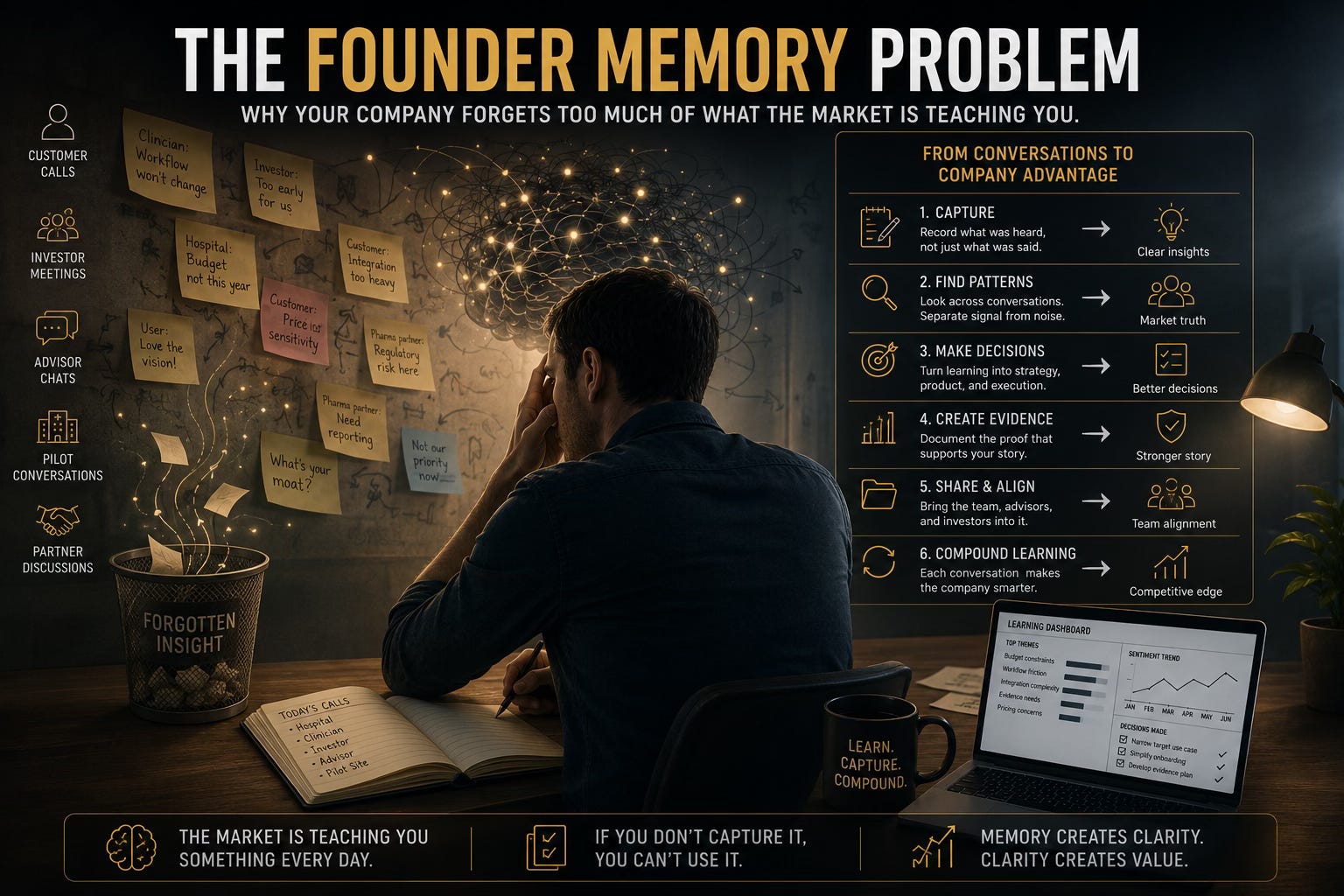
The best founders do not treat conversations as proof by themselves. They treat conversations as raw material. They capture what they heard, compare it across stakeholders, identify repeated patterns, separate signal from noise, and then make decisions. That is how learning becomes strategy.
The founder becomes the bottleneck for insight
In the earliest days of a company, it is normal for most learning to sit with the founder. The founder is taking the calls, hearing the objections, adjusting the pitch, interpreting the feedback, and making decisions in real time. That is part of the job. Early companies move through founder intensity.
But as the company develops, this becomes risky. If the founder is the only person who remembers why certain decisions were made, what customers really said, which investor objections keep repeating, what the pilot partner cared about, or why one market was chosen over another, the company becomes dependent on the founder's memory. The team cannot learn properly because the learning is not visible. New hires cannot understand the market quickly because the insight is not organised. Advisors repeat old advice because they do not see what has already been tested. Investors hear claims without the underlying evidence.
This is one of the hidden reasons early companies become inefficient. The founder keeps carrying the context personally. Every new discussion requires the founder to re-explain the market. Every strategic decision depends on what the founder remembers. Every investor update has to be rebuilt from memory. Every product debate returns to old conversations because the company has no shared source of truth.
A founder’s memory is not an operating system.
It may work for a while, especially when the company is very small. But it does not scale. As the company raises capital, hires people, runs pilots, manages advisors, builds product, and speaks to investors, the learning needs to become institutional. The company needs a way to remember what the market has taught it so that insight can compound.
This is not about bureaucracy. It is about discipline. If the company does not capture learning, it keeps paying for the same lessons again.
Investor feedback is often wasted
One of the biggest areas where founders lose value is investor feedback. Fundraising creates a huge amount of information. Every investor conversation tells the founder something about how the company is being perceived. Some investors misunderstand the story. Some focus on the same risk. Some ask the same question in different ways. Some react strongly to one part of the company and ignore another. Some pass because of fund fit, but others pass because the company has not yet answered a real concern.
Founders often leave these calls emotionally rather than analytically. A good call creates optimism. A bad call creates frustration. A pass creates disappointment. A positive follow-up creates energy. But the deeper value is in the pattern. What did investors consistently not understand? Where did they slow down? What did they challenge? What did they believe quickly? What did they discount? Which questions kept coming back?
If this feedback is not captured, the founder may keep repeating the same fundraising mistake. The deck gets adjusted superficially, but the underlying issue remains. The founder changes a phrase but does not change the logic. The company keeps hearing that the market entry is unclear, the evidence is too early, the buyer is not well defined, the platform story is too broad, or the use of funds does not connect to value creation. But because the feedback is not organised, it feels like an isolated investor opinion rather than a pattern.
This is dangerous because investors are not always good at explaining exactly why they are uncomfortable. Sometimes they ask questions about the real concern rather than naming it directly. It is the founder’s job to interpret the pattern. If five relevant investors hesitate around the same part of the story, that is not noise. That is market feedback.
The best founders treat fundraising as a learning process, not just a capital process. Even when they do not get the cheque, they extract insight from the conversation. They use investor feedback to sharpen the narrative, improve the data room, refine the milestone plan, and understand what the next round will need to believe.
Customer learning disappears too easily
The same problem happens with customers and users. A founder may have dozens of conversations with clinicians, hospital leaders, patients, payers, pharma teams, or operational staff, but the learning stays too fragmented. One conversation reveals a workflow pain. Another reveals a budget issue. Another reveals a reason the product would not be adopted. Another reveals that the user and buyer are not the same person. Another reveals that the problem matters, but not enough to become a priority this year.
Each insight matters, but only if the company connects them.
Without a disciplined memory, the founder may overvalue the positive signals and forget the uncomfortable ones. The clinician who loved the product is remembered. The procurement concern is softened. The pilot interest is repeated in the deck. The lack of budget is treated as a later issue. The company remembers what creates momentum and forgets what creates friction.
This is human. Founders are trying to survive. They need energy. They need optimism. They need to keep moving. But selective memory can weaken the company. If the same objection appears across multiple customer conversations and the founder does not capture it properly, the product roadmap may move in the wrong direction. If budget concerns appear early and are ignored, the commercial model may be built on wishful thinking. If workflow resistance appears repeatedly and is not documented, the company may later discover that adoption is harder than expected.
In health, this is especially important because customer feedback often contains hidden complexity. A clinician may be describing workflow risk. A finance stakeholder may be describing budget priority. An IT contact may be describing the integration burden. A compliance person may be describing institutional risk. These comments may sound operational, but they often reveal whether the product can actually be adopted.
If the company forgets those signals, it will build around a version of the market that does not exist.
The company needs a learning discipline
A founder does not need a complicated system to solve this problem, but they do need a discipline. The goal is not to turn every conversation into a report. The goal is to make sure important learning does not disappear.
The discipline starts with capturing what was actually learned, not just what was said. This distinction matters. A transcript is not insight. A meeting note is not a strategy. The founder needs to ask what the conversation revealed about the problem, buyer, urgency, evidence, pricing, adoption, risk, milestone, or fundraising story. The value is not in recording everything. The value is in interpreting what matters.
The second part is pattern recognition. One comment may be noise. Repeated comments become evidence. If multiple clinicians describe the same workflow barrier, that matters. If multiple investors struggle with the same part of the story, that matters. If multiple buyers avoid pricing, that matters. If multiple pilot sites show interest but no budget, that matters. If multiple advisors disagree, the founder needs to understand whether the disagreement is contextual or strategic.
The third part is decision-making. Learning is only useful if it changes something. It may change the pitch, the product, the roadmap, the evidence plan, the target customer, the fundraising strategy, the hiring plan, or the next milestone. It may also confirm that the company should not change direction yet. Either way, the founder should be able to explain how market learning is being turned into company action.
This is what investors want to see. They want to know that the founder is not only collecting conversations but also becoming sharper because of them. A company that learns quickly is more investable than a company that simply works hard.
Memory creates better fundraising materials
One of the most practical benefits of founder memory is that it makes fundraising materials stronger. A company that captures learning properly can build a better deck, a better data room, better investor updates, and better diligence answers because the evidence is not being reconstructed from memory at the last minute.
When customer conversations are captured well, the market section becomes more specific. The founder can explain who feels the pain, why it matters, how often it appears, who controls the budget, and what adoption barriers exist. When investor feedback is captured well, the fundraising narrative becomes sharper. The founder can see which claims are confusing, which risks need better explanation, and which parts of the story create conviction. When pilot learning is captured well, the traction section becomes more credible because the founder can explain what was tested, what was learned, and what still needs to be proven.
This is how insight becomes evidence.
Too many founders treat the data room as a place to upload documents after the fact. But the best fundraising materials are built from disciplined learning over time. The deck should reflect what the company has learned from the market. The data room should support the claims made in the story. The investor update should show progress against the risks that matter. The milestone plan should reflect what the company has learned about what needs to become true next.
A founder who has captured learning can answer investor questions with confidence because the answers are grounded in real conversations and real patterns. A founder who has not captured learning often answers from memory, and memory becomes vague under pressure.
The market is teaching you what to build
The market is always teaching the founder something. It teaches through enthusiasm, hesitation, delay, objections, confusion, silence, budget resistance, feature requests, pilot friction, investor questions, advisor disagreement, and customer behaviour. The challenge is that the market rarely teaches in a clean way. It does not hand the founder a strategy. It provides signals, and the founder has to interpret them.
This is why founder memory matters. If the company does not remember the signals, it cannot interpret the pattern. If it cannot interpret the pattern, it cannot make better decisions. It may keep building what the founder wants to build instead of what the market is showing it needs. It may keep selling to the wrong stakeholder. It may keep targeting the wrong use case. It may keep pitching the wrong story to investors.
The best founders understand that strategy is not only created in a planning session. It is built from what the company learns through contact with the market. The market may teach that the buyer is different from the user. It may teach that the strongest use case is narrower than expected. It may teach that the product is valuable, but only if implementation is simpler. It may teach that investors do not understand the platform until the first wedge is explained. It may teach that the company needs more evidence before the next round.
Those lessons are expensive. The founder should not have to learn them twice.
P.S. Don’t forget to check out HealthVC on YouTube and The Terminology of Venture Capital on Amazon.
