
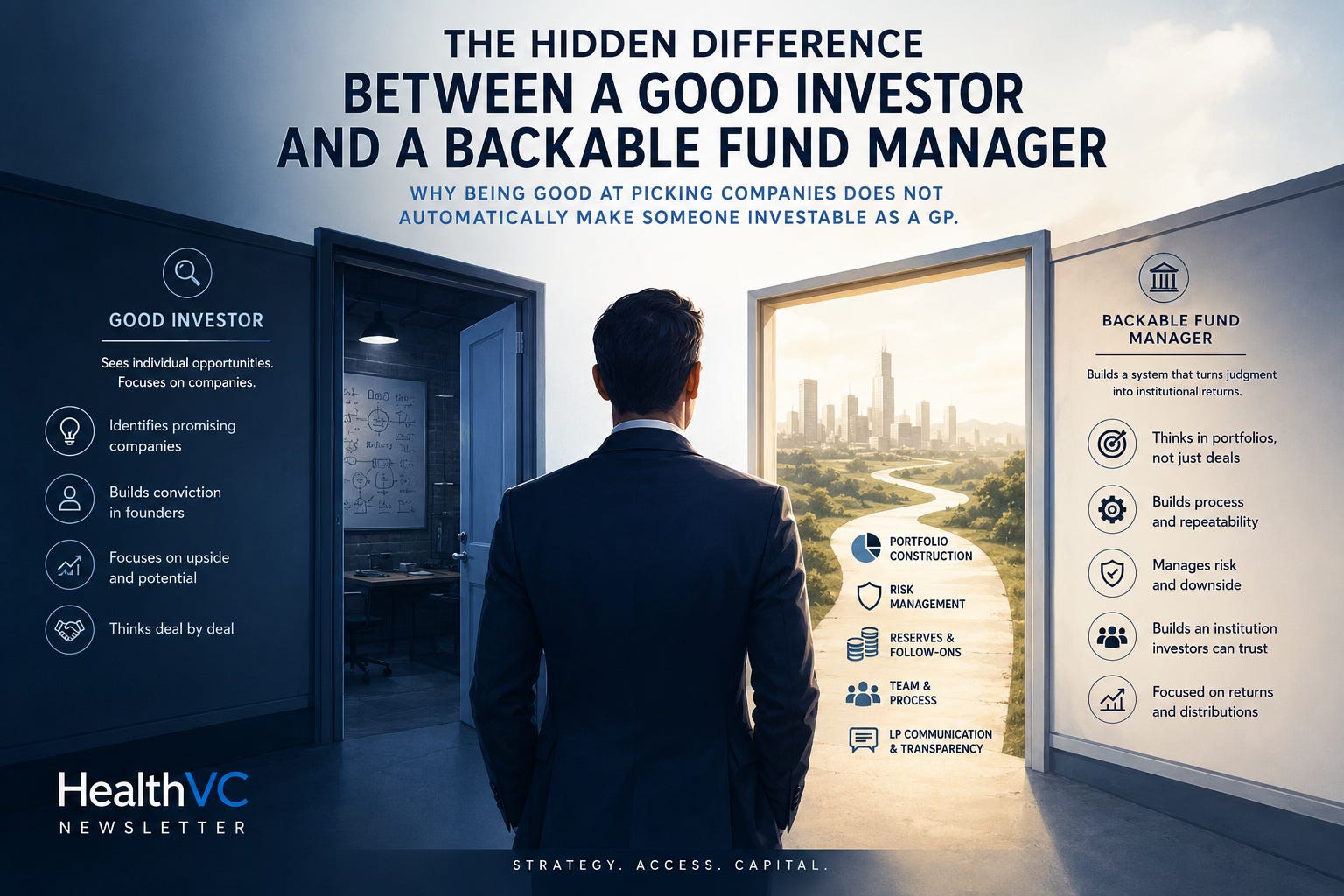
The Hidden Difference Between a Good Investor and a Backable Fund Manager
Why being good at picking companies does not automatically make someone investable as a GP.

Dear Readers,
Welcome to the latest edition of the HealthVC newsletter. HealthVC is the go-to newsletter for founders, LPs, and emerging managers who want to master fundraising, build institutional-grade data rooms, and understand how investors actually make decisions.
One of the biggest mistakes emerging managers make is assuming that being a good investor is enough.
It is understandable.
If you have sourced good companies, helped founders, spotted markets early, built strong relationships, and developed a clear point of view, it feels logical that LPs should want exposure to that judgment. You have seen things other investors missed. You have access that others do not have. You can explain why certain companies matter before the market fully understands them.
That is the foundation of becoming a fund manager.
But it is not the same as being a backable fund manager.
LPs are not only asking whether you can identify good companies. They are asking whether you can build a vehicle that turns investment judgment into institutional returns over time. They are underwriting your ability to source, select, win allocation, construct a portfolio, manage reserves, communicate with investors, handle pressure, and eventually return capital.
That is a much bigger question than whether you have good taste.
This is where many emerging managers struggle. They spend the majority of their fundraising process proving that they understand companies, markets, founders, and categories. They talk about deal flow. They talk about access. They talk about their network. They talk about the companies they backed or wish they had backed.
All of that matters.
But LPs are listening for something else as well.
They are trying to understand whether the manager can operate a fund.
A fund is not just a collection of investments. It is a system. It has a strategy, a model, a pacing plan, a reserve policy, a reporting rhythm, a decision process, a governance structure, and a long-term relationship with capital providers. It must survive uncertainty, missed deals, founder issues, markdowns, follow-on decisions, delayed exits, and changing market conditions.
A good investor may be able to pick a company.
A backable fund manager must be able to build an institution around that judgment.
That is the hidden difference.
And it is the difference that many LPs are quietly trying to assess before they write the check.
One thing worth noting before we get into it. These are exactly the kinds of conversations we are building the HealthVC Summit around in Zurich on September 2nd and 3rd. A curated room of LPs, GPs, sovereign allocators, family offices, and founders working through how capital actually moves across Europe, China, and Saudi Arabia. Not passive networking. Not surface-level panels. Real capital alignment, real decision making, and the private conversations that shape allocation.
Register for the HealthVC Summit
Good Investors See Companies. Backable Managers See Portfolios.
The first difference between a good investor and a backable fund manager is the unit of thought.
A good investor often thinks company by company. They see a founder, a market, a product, a piece of technology, or a commercial opening, and they ask whether this individual opportunity is compelling. They develop conviction around the company. They decide whether the upside justifies the risk. They think deeply about why this founder, this timing, and this market could produce a meaningful outcome.
That is important. Without company-level judgment, there is no venture fund.
But a fund manager has to think one level higher.
They have to ask how each company fits into the portfolio. They have to understand what role the investment plays inside the fund. They have to know whether the check size, ownership target, follow-on requirement, risk profile, and exit pathway make sense relative to the rest of the portfolio.
This is a very different discipline.
An individual company can be interesting and still be wrong for the fund. It may require too much follow-on capital. It may sit outside the fund’s core thesis. It may have a long path to liquidity that does not match the portfolio’s timing needs. It may be attractive, but not capable of returning enough capital at the ownership level the fund can realistically secure.
LPs notice whether a manager understands this.
They are not only listening to how the manager talks about great companies. They are listening to how the manager talks about portfolio construction. They want to know how many companies the fund will back, what ownership it needs, how reserves will be allocated, how winners will be supported, and how the fund can return capital if only a small number of companies drive the majority of outcomes.
This is where many emerging managers reveal that they are still thinking like investors rather than fund managers.
They can explain why a company is exciting, but they cannot explain how the fund math works. They can describe the opportunity set, but they cannot connect it to ownership, dilution, reserves, exit sizes, and return pathways. They can talk about the upside, but not enough about construction.
That creates doubt.
LPs know that venture returns are not created by enthusiasm alone. They are created by the interaction between selection, ownership, follow-on discipline, and exit value. A manager can pick good companies and still fail to return the fund if they own too little, reserve poorly, over-diversify, under-diversify, or deploy into a strategy where the exit outcomes do not support the fund size.
This is especially important in healthtech and life sciences because the capital needs, timelines, regulatory pathways, and exit dynamics can differ dramatically across subsectors. A medtech company, a diagnostics platform, a clinical workflow software company, and a biotech asset do not behave the same way inside a portfolio. They require different capital, different syndicates, different timelines, and different exit logic.
A backable fund manager understands that.
They do not just say, “This is a great company.” They say, “This is the kind of company that fits our return model, our ownership strategy, our reserve plan, and our fund size.”
That is the shift LPs are looking for.
They want to see the manager move from company conviction to portfolio discipline.
Because a fund is not judged by whether it backed some good companies.
It is judged by whether the portfolio was constructed in a way that could return capital.
Good Investors Have Taste. Backable Managers Have Process.
Taste matters in venture.
The best investors often see quality before it is obvious. They can sense when a founder has something unusual. They can detect when a market is shifting. They can identify a product that feels early but directionally correct. They can look at an incomplete company and understand what it could become.
That kind of judgment is real.
But LPs cannot underwrite taste alone.
Taste is difficult to verify, difficult to repeat, and difficult to separate from timing until years later. A manager may have backed one or two strong companies, but the LP still has to ask whether those outcomes came from a repeatable process or from a small number of fortunate decisions.
This is why process matters so much.
A backable manager can explain how decisions are made. They can show how opportunities enter the pipeline, how they are filtered, how conviction is built, how risks are identified, how price is assessed, how ownership is negotiated, and how final decisions are made.
They can also explain what they do not invest in.
That is often more revealing than what they like.
Many emerging managers are good at describing the companies they want to back. Fewer are good at explaining the companies they pass on. But pass decisions are where the process becomes visible. They show whether the manager has discipline, whether the thesis has boundaries, and whether the team can resist deals that are attractive but inconsistent with the fund's strategy.
LPs listen carefully for this because venture is full of temptation.
A manager will see exciting companies outside the core thesis. They will be offered allocation in rounds led by famous funds. They will meet charismatic founders. They will feel pressure to deploy. They will worry about missing momentum. They will be tempted to stretch.
A good investor may chase the opportunity.
A backable fund manager knows when the opportunity is not right for the fund.
That is the difference.
Process does not mean bureaucracy. It does not mean slow decision-making. It does not mean turning venture into a mechanical exercise. Venture still requires judgment, pattern recognition, and conviction before all the evidence is available.
But the judgment has to sit inside a repeatable framework.
LPs want to understand how the manager thinks when the answer is not obvious. They want to know how the manager handles conflicting signals. They want to know what happens when the founder is excellent, but the market is unclear, or when the market is attractive, but the team is incomplete, or when the technology is strong, but the commercial pathway is weak.
The more clearly a manager can explain those decisions, the more underwritable they become.
This is why investment memos, IC notes, pipeline reviews, and post mortems matter. They reveal whether the manager has a real decision architecture or simply a strong narrative after the fact.
A good investor can tell a compelling story about why they invested.
A backable manager can show how that decision fits into a repeatable pattern.
That is what LPs are trying to find.
Good Investors Win Deals. Backable Managers Win the Right Deals at the Right Ownership.
Deal access is one of the most overused phrases in fundraising.
Every manager says they have access. Every manager says they see proprietary opportunities. Every manager says founders want them on the cap table. Every manager says they can get into competitive rounds.
LPs have heard all of it.
What they are really asking is more precise.
Can this manager win the right deals, at the right price, with the right ownership, often enough for the fund model to work?
That is a very different question.
A good investor may be invited into interesting rounds. A backable manager understands whether the allocation is meaningful enough to matter. They know that being on the cap table is not the same as building a fund return. They understand that a small allocation in a great company may be reputationally useful but economically irrelevant if the ownership is too low to move the fund.
This matters because many emerging managers build their story around access without fully addressing ownership.
They show impressive company logos. They mention well-known co-investors. They reference competitive rounds. The surface area looks strong. But when LPs look more closely, they may find that the actual ownership is small, the entry price is high, the check was squeezed in late, or the manager had limited influence on the round.
That does not mean the investment is bad.
But it may not prove what the manager thinks it proves.
LPs are not simply looking for evidence that the manager can get into good companies. They are looking for evidence that the manager can build positions that can return capital. That requires sourcing, but it also requires trust with founders, clarity of value, speed, pricing discipline, and the ability to negotiate allocation before the round becomes crowded.
This is where the distinction between access and edge becomes important.
Access means the manager can see the opportunity.
Edge means the manager can act on it in a way that improves fund outcomes.
A manager with true edge does not just receive the deck. They understand why they are seeing the opportunity, why the founder wants them involved, why they can win allocation, and why the terms make sense for the fund. They can explain how that access repeats across the strategy, not just through isolated relationships.
LPs want to know whether the manager’s access is structural or personal.
Personal access can be valuable, especially in Fund I. But structural access is more durable. It comes from a clear market position, a trusted network, a repeatable sourcing channel, a specialist reputation, or a role in the ecosystem that consistently brings the right founders into the manager’s orbit.
This is particularly relevant in specialist markets. In healthtech and life sciences, founders often need more than capital. They may need help with clinical validation, reimbursement logic, regulatory strategy, pharma partnerships, hospital pilots, or international expansion. If a manager can credibly help with those things, access becomes more than networking. It becomes a reason for founders to choose that fund.
But again, LPs will ask whether the evidence supports the claim.
Do founders say the manager helped them before the investment? Do strong companies come to the manager early? Does the manager see deals before they are widely syndicated? Can they win ownership in situations where other investors also want access? Do they have a clear reason to exist on the cap table?
A good investor may know a lot of founders.
A backable fund manager can convert that access into ownership that matters.
That is what LPs are underwriting.
Good Investors Explain Upside. Backable Managers Explain Risk.
Most investors are good at explaining upside.
They can describe the size of the market, the strength of the founder, the urgency of the problem, the timing of the category, and the scale of the potential outcome. This is natural. Venture is built on the ability to believe in something before the market fully accepts it.
But LPs do not only want to know what could go right.
They want to know whether the manager understands what could go wrong.
This is where many emerging managers unintentionally weaken their case. They spend too much time selling the opportunity and not enough time demonstrating risk awareness. They talk about why the fund can win, but not enough about where the strategy could fail, what assumptions must hold, and how the fund is designed to survive mistakes.
A backable manager does not hide risk.
They make risk legible.
They explain the risks that matter most and show how they think about them. They do not pretend that every company will work. They do not pretend every follow-on decision will be obvious. They do not pretend that exits will arrive on schedule. They do not confuse conviction with certainty.
This is extremely important because LPs know that venture funds are long, messy, uncertain vehicles. The relationship may last ten years or more. During that time, there will be companies that miss milestones, rounds that become difficult, valuations that reset, exits that delay, and founders who need support through uncomfortable periods.
The LP wants to know how the manager will behave when that happens.
A manager who only talks about upside can feel promotional. A manager who can talk clearly about risk feels more institutional.
That does not mean the manager should sound cautious or defensive. It means they should sound mature. They should know which risks are acceptable, which risks are avoidable, and which risks are fatal to the fund strategy.
For example, in healthtech, clinical adoption risk is different from regulatory risk. Reimbursement risk is different from enterprise sales risk. Scientific risk is different from market access risk. A manager who treats all risk as generic uncertainty does not inspire confidence. A manager who can separate these risks and explain how they underwrite each one becomes more credible.
The same is true at the fund level.
LPs want to know what happens if the deployment pace slows. They want to know what happens if follow-on rounds require more capital than expected. They want to know what happens if the exit timelines extend. They want to know what happens if the best companies need reserves earlier than planned. They want to know what happens if the fund cannot secure target ownership in the most competitive deals.
These are not negative questions.
They are underwriting questions.
A good investor may be able to explain why the opportunity is attractive. A backable manager can explain why the opportunity is attractive despite the risk, and how the fund has been designed to manage that risk.
That is a much stronger position.
LPs do not expect certainty. They expect clarity.
And risk clarity is one of the strongest signals of fund manager maturity.
Good Investors Communicate When Things Are Going Well. Backable Managers Communicate When Things Get Hard.
Communication is often treated as a secondary part of fund management.
It should not be.
For LPs, communication is one of the clearest indicators of whether a manager is institutional. Not because LPs need constant updates, but because the way a manager communicates reveals how they think, how they handle pressure, and how seriously they take the relationship with their capital providers.
Many good investors can communicate well when things are going well. They can share positive updates, new investments, markups, founder wins, strategic partnerships, and pipeline momentum. Those updates are important, but they are the easy part.
The harder test is how a manager communicates when things become uncomfortable.
When a company misses its plan.
When a financing round is delayed.
When a valuation is marked down.
When a founder issue emerges.
When deployment is slower than expected.
When reserves need to be reconsidered.
When the fund’s early assumptions need to be updated.
This is where LP trust is either strengthened or weakened.
A backable manager understands that LP communication is not public relations. It is not about making every update sound positive. It is about helping LPs understand what is happening, why it matters, what the manager is doing about it, and how the situation affects the fund.
That requires honesty, structure, and judgment.
Emerging managers sometimes avoid difficult communication because they fear it will damage confidence. In reality, the opposite is often true. LPs usually understand that venture is uncertain. What damages confidence is not bad news itself. It is surprise, vagueness, defensiveness, or the feeling that the manager does not have control of the narrative.
A manager who communicates clearly through difficulty becomes more trusted.
They show that they can manage the relationship over time. They show that they are not only good at fundraising but also capable of being a steward of capital. They show that they can separate facts from interpretation, and interpretation from action.
That matters because LPs are making a long-term commitment.
They are not just evaluating a deck. They are evaluating the person and firm they will be in a relationship with throughout the full life of the fund. They need to believe the manager will provide transparency, not performance theatre. They need to believe the manager will share context early, not after problems have already compounded.
This is why strong quarterly updates, capital call discipline, portfolio reviews, valuation commentary, and honest reflections on performance matter. They are not administrative details. They are part of the institutional product.
A good investor may generate strong investments.
A backable fund manager makes LPs feel informed, respected, and able to trust the process even before liquidity arrives.
That trust compounds.
And for emerging managers, trust is one of the most important assets they have.
Good Investors Want to Prove They Are Right. Backable Managers Want to Improve Their Decision Making.
There is a psychological difference between a good investor and a backable fund manager that LPs often sense before they can fully articulate it.
Some investors are primarily trying to prove they are right.
They want to show that their thesis is correct, that their access is better, that their market read is sharper, and that their past decisions validate their future fund. This is natural, especially during fundraising. The manager is trying to build confidence. They want LPs to believe they have an edge.
But the best fund managers are not only trying to prove they are right.
They are trying to improve how they make decisions.
This distinction matters because venture is not a game of perfect foresight. Every manager will be wrong. Every fund will include mistakes. Every strategy will face market conditions that were not fully anticipated at the time of fundraising.
LPs know this.
They are not looking for a manager who has never been wrong. They are looking for a manager who learns properly.
This is why the way a manager talks about mistakes is so important. Some managers explain every miss as bad timing, market conditions, founder execution, or external circumstances. Sometimes those explanations are true. But if every mistake is externalized, the LP learns something about the manager.
They learn that the manager may not be improving.
A backable manager can analyze mistakes without becoming defensive. They can explain what they believed at the time, what changed, what they missed, what they would do differently, and how the process has evolved as a result. They do not overperform humility, but they do show self-awareness.
That is powerful because self-awareness is a leading indicator of process improvement.
LPs understand that early funds are imperfect. They understand that Fund I and Fund II managers may still be building their firm, refining their strategy, and learning what part of their edge is truly repeatable. The question is not whether everything is already perfect. The question is whether the manager is becoming better at the right things.
This is also why post-mortems matter.
A manager who reviews their own decisions seriously is more credible than one who only celebrates wins. They can identify patterns. They can see where conviction was justified and where it was emotional. They can distinguish between a good decision with a bad outcome and a bad decision that happened to work.
That is rare.
Many people in venture are skilled at storytelling after the fact. Fewer are disciplined about learning before the next decision.
A good investor may have strong instincts.
A backable manager builds a system that improves those instincts over time.
That is what LPs want to see.
Because in a ten-year fund, the manager’s learning rate matters.
P.S. Don’t forget to check out the HealthVC on YouTube and The Terminology of Venture Capital on Amazon.