
The Invisible Implementation Cost
Why healthtech startups lose sales even when the product works, the buyer is interested, and the problem is real.

Dear Readers,
Welcome to the latest edition of the HealthVC newsletter. HealthVC is the go-to newsletter for founders who want to master fundraising, build institutional-grade data rooms, and understand how investors actually make decisions.
Today, we are diving deep into one of the most overlooked reasons healthtech startups struggle to sell: the invisible implementation cost. Understanding this is essential for any founder building in healthcare, because buyers do not only evaluate whether your product works. They evaluate how much effort, disruption, coordination, risk, and internal work it will take to actually adopt it. In this issue, we explore why implementation is often the hidden reason deals slow down, pilots stall, procurement drags, and interested buyers disappear. Whether you are selling to hospitals, pharma companies, payers, clinics, employers, or care providers, this newsletter is your guide to understanding why healthcare buyers hesitate even when they like the product. Join us as we unpack the invisible implementation cost and why mastering it can completely change how founders sell, scale, and raise capital.
The product is not the only thing the buyer is evaluating
Most healthtech founders believe the buyer is mainly deciding whether the product is good enough.
That is only partly true.
In reality, the buyer is also deciding whether their organisation can absorb the work required to adopt it. This is where many founders misunderstand healthcare sales. They assume that if the problem is painful, the product is useful, the evidence is strong, and the ROI is clear, the deal should move forward. But healthcare does not work like that.
Healthcare organisations are not clean operating environments waiting for better technology. They are overloaded systems with clinical pressure, regulatory responsibility, staff shortages, legacy infrastructure, internal politics, procurement rules, budget constraints, and deeply embedded workflows. A new product does not enter an empty space. It enters a system that is already full.
That is why a buyer can agree with the founder and still not buy. They can understand the problem and still not move. They can like the demo and still disappear. They can believe the product could help and still delay the decision for months.
The reason is often not a lack of interest.
It is an implementation burden.
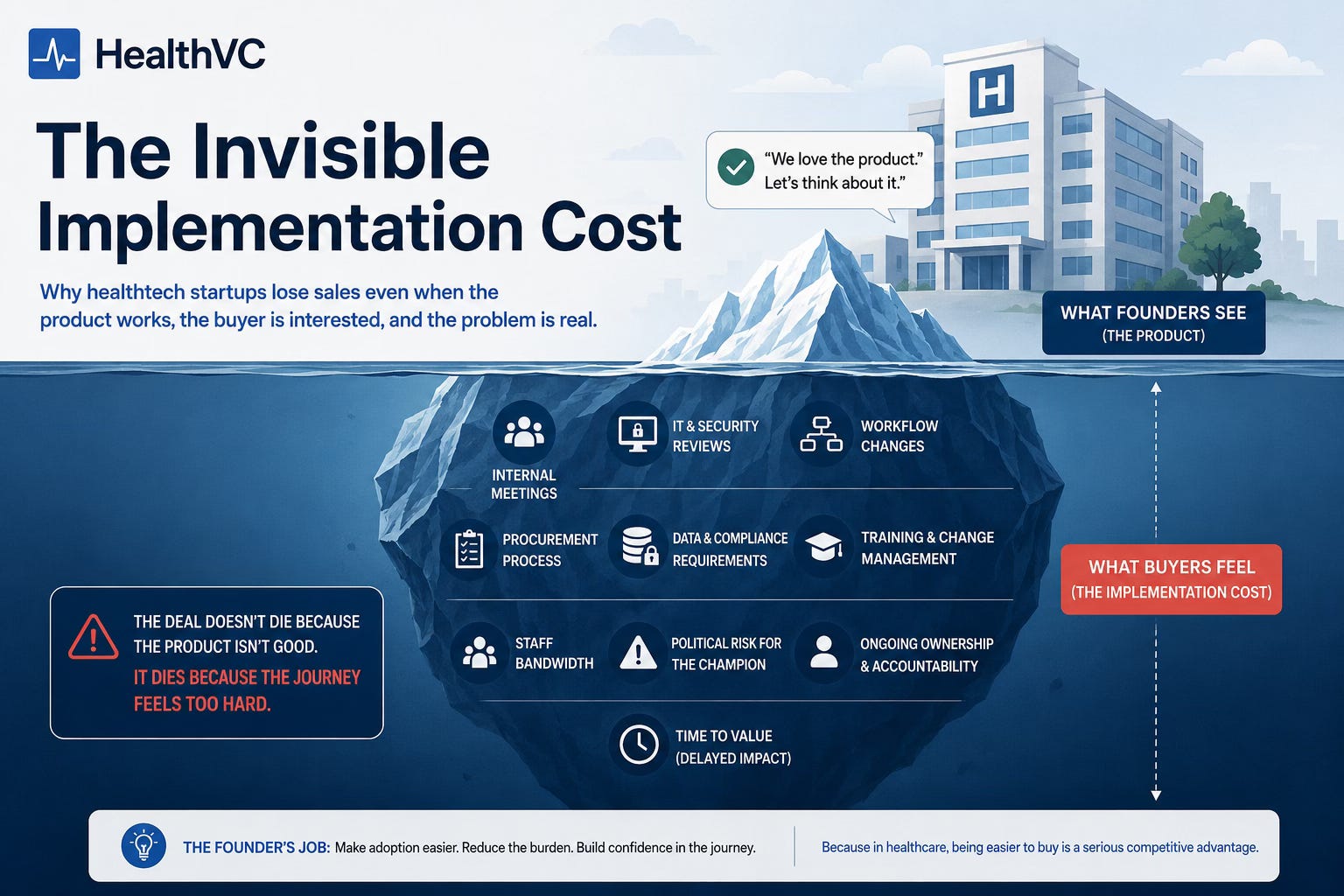
The founder sees a product.
The buyer sees a project.
That gap is the invisible implementation cost.
Implementation is not onboarding
Most startups describe implementation as onboarding.
They think it means setting up the account, training the customer, connecting the system, and getting the first users live. But in healthtech, implementation is much bigger than onboarding. It is the total organisational burden created by adopting the product before the product creates value.
It is the internal meetings. It is the IT review. It is the clinical workflow change. It is the procurement process. It is the data governance discussion. It is the security questionnaire. It is the training burden. It is the staff communication. It is the change management. It is the political risk for the internal champion. It is the question of who owns the product after the contract is signed.
This cost is often invisible to the founder because it does not sit inside the product.
It sits inside the customer.
That is why so many founders misread buyer behaviour. They think silence means the buyer was not serious. They think delays mean the procurement team is slow. They think a lack of usage means the customer is lazy. Sometimes that may be true. But very often, the real issue is that the startup has created more internal work than the buyer is able or willing to carry.
Healthcare buyers are not only buying software, devices, diagnostics, analytics, workflow tools, patient engagement platforms, or AI systems. They are buying the operational reality that comes with them.
Every value proposition has an implementation shadow
A founder may say, “We reduce clinician workload.”
The buyer hears, “Which clinician has to change their current workflow first?”
A founder may say, “We integrate with existing systems.”
The buyer hears, “How much IT time will this take, and who is going to approve it?”
A founder may say, “The dashboard gives leadership better visibility.”
The buyer hears, “Who will actually look at this, who will act on the data, and what happens if nobody owns it?”
A founder may say, “Patients can use this from home.”
The buyer hears, “Who explains this to patients, who follows up when they do not engage, and who handles the exceptions?”
This is the reality of healthtech adoption. Every value proposition has an implementation shadow. The stronger the founder, the more clearly they understand that shadow.
The mistake many founders make is that they sell the future state without explaining the transition state. They sell the world after the product has been adopted. They show the efficiency, the savings, the better patient experience, the improved data, the faster triage, the cleaner workflow, the reduced admin burden, or the stronger clinical outcomes.
But the buyer is living in the present state.
They are asking how to get from where they are today to the future the founder is describing.
That journey is where deals slow down.
The buyer has to survive the transition
The buyer may believe the future state is better.
But if the transition looks painful, unclear, risky, or politically difficult, they may choose to stay with the status quo. Not because the status quo is good, but because the status quo is known.
In healthcare, known pain often beats unknown complexity.
This is one of the most frustrating lessons for founders. Being better is not enough. Being adoptable matters just as much. A healthtech company can have a better product and still lose to inertia. It can have a stronger clinical case and still lose to internal complexity. It can have a convincing ROI model and still lose because nobody inside the organisation has the bandwidth to implement it.
That is why founder-led selling in healthcare has to go beyond persuasion.
It has to reduce the buyer’s perceived operational risk.
A serious buyer does not only want to know why your product matters. They want to know what it will take to make it work inside their organisation. They want to know who needs to be involved. They want to know how long it will take. They want to know what resources are required. They want to know what could go wrong. They want to know what has gone wrong with similar customers. They want to know what the first thirty, sixty, and ninety days look like. They want to know whether your team has done this before.
This is why saying “implementation is easy” is often weak.
Buyers do not want vague reassurance.
They want operational confidence.
The strongest founders sell the path, not just the product
The founder who says “we are easy to implement” sounds like they are trying to remove concern.
The founder who explains the implementation pathway sounds like they understand the buyer.
There is a big difference.
The best healthtech founders do not pretend there is no implementation burden. They map it. They explain it. They reduce it. They show the buyer what has to happen, who has to be involved, what the startup will own, what the customer needs to prepare, and how success will be measured.
They turn implementation from an unknown risk into a managed process.
That is where trust starts to build.
Trust in healthtech does not come only from evidence. It comes from the buyer believing that the founder understands the operating environment. It comes from the founder showing that they know how healthcare organisations actually behave. It comes from proving that the product is not just impressive, but deployable.
The better founder does not only sell the clinical case.
They sell the operational path.
Why this matters to investors
This matters deeply for fundraising.
Investors do not only want to know whether customers like the product. They want to know whether customers can adopt it repeatedly without the company breaking under the weight of implementation.
A startup can have exciting pilots and still be hard to scale if every customer requires a different onboarding process, different integration work, different training materials, different success metrics, and heavy founder involvement.
That is when a company starts to look less like software and more like a services business.
This is one of the hidden reasons investors dig into the quality of revenue. They are not only looking at logos. They are looking at whether those logos are live, active, expanding, renewing, and producing repeatable evidence. They want to understand how long it takes to go from a signed agreement to active usage. They want to understand how much hand-holding is required. They want to understand whether customer success is scalable. They want to understand whether implementation improves over time or becomes more complex with each new customer.
A founder may say, “We have five hospital pilots.”
An investor may ask, “How many are live?”
A founder may say, “We signed a strategic partnership.”
An investor may ask, “What is actually being used?”
A founder may say, “The buyer loved the product.”
An investor may ask, “Who owns implementation inside the customer?”
A founder may say, “We are expanding across the system.”
An investor may ask, “What evidence shows this can be repeated with the next customer?”
This is why implementation is not only a sales problem. It is a company building problem. It affects sales cycle length, gross margin, customer success, retention, expansion, working capital, founder capacity, and investor confidence.
The implementation cost eventually appears in the numbers
The invisible implementation cost often shows up later in the metrics.
It appears as delayed revenue recognition. It appears as pilots that never convert. It appears as low usage after signing. It appears as customer success teams are becoming overloaded. It appears as sales cycles that keep stretching. It appears as founders are spending too much time saving accounts instead of building the company. It appears as an impressive pipeline but weak conversion.
By the time it appears in the metrics, the root cause has usually been present for months.
The company did not make adoption easy enough.
This is why the best founders think about implementation before the buyer asks. They do not wait until procurement to discover the blockers. They do not wait until after signing to figure out internal ownership. They do not wait until onboarding to realise the workflow is more complicated than expected.
They design the adoption path as part of the commercial strategy.
That means the sales process should not only qualify the budget and need. It should qualify for implementation capacity. Can this organisation actually adopt the product now? Who has to approve it? Who has to use it? Who has to support it? Who has to defend it internally? What workflow has to change? What does the buyer need before launch? Who owns success after launch? What would make this fail even if the product works?
These are not minor details.
They are the difference between interest and adoption.
Make the first step smaller
A founder who understands this sells differently.
They stop treating implementation as something that happens after the sale. They bring implementation into the sale itself. They show the buyer what the first use case should be. They make the first step smaller. They define the internal owner. They make the success metric simple. They reduce the number of stakeholders needed for the first deployment. They give the champion materials to sell internally. They make the buyer feel that adoption is not another major transformation project.
This is especially important in healthcare because many buyers have been burned before.
They have seen pilots that went nowhere. They have seen platforms that required too much training. They have seen integrations that dragged on for months. They have seen products that leadership liked but frontline teams ignored. They have seen vendors disappear after signing. They have seen tools that created more admin work than they removed.
So when a new founder arrives with another promising solution, the buyer is not starting from a neutral position.
They are carrying the memory of previous implementation pain.
That is why founders need to make the change feel smaller.
Not the ambition.
The change.
The biggest vision can still be there. The founder can still build toward a platform, a category, or a system-level transformation. But the first step for the buyer has to feel manageable. The buyer needs to see a narrow entry point, a clear owner, a simple workflow, a fast proof point, and a realistic adoption path.
The stronger founder does not try to sell the entire transformation on day one.
They sell the first piece of the transformation that the buyer can actually absorb.
The real lesson
Your buyer may believe in the destination.
But they still need confidence in the journey.
The real question is not only, “Does this product create value?”
The real question is, “Can this organisation reach that value without creating too much pain along the way?”
That is the invisible implementation cost.
And for many startups, it is the reason the deal does not move.
The founder thinks the buyer is evaluating innovation. The buyer is evaluating effort. The founder thinks the buyer is comparing solutions. The buyer is comparing disruption. The founder thinks the buyer is deciding whether the product is useful. The buyer is deciding whether the organisation has the capacity to change.
Once founders understand this, the sales conversation improves.
They stop over relying on the demo. They stop assuming ROI will carry the deal. They stop confusing interest with readiness. They stop treating implementation as a post-sale function. They start building the adoption case as carefully as they build the product case.
That is when healthtech companies become easier to buy.
And in healthcare, being easier to buy is a serious competitive advantage.