
The Milestone Trap

Hi everyone,
Welcome back to HealthVC, where we break down how capital really moves in healthtech, life sciences, and venture-backed healthcare companies.
Most founders eventually say the same thing when they are raising capital. “We are raising this round to get to the next milestone.” On the surface, this sounds sensible. It sounds disciplined. It tells investors there is a plan. It suggests the company is not raising money simply to survive, but raising money to move the business forward.
The problem is that many founders misunderstand what a milestone is supposed to do. A milestone is not just the next item on the company roadmap. It is not just a product release, a pilot launch, a regulatory submission, a new hire, a data readout, a commercial partnership, or twelve more months of runway. Those things may all matter. They may be necessary. They may even be impressive. But they are not automatically financing milestones.
A financing milestone has a very specific job. It has to change the next investor’s level of belief. That is where many founders get caught. They raise a Seed round to build the product. They raise a bridge to complete pilots. They raise another extension to hire commercial leadership. They raise again to produce more data. Each step feels like progress inside the company. The team is working hard. The roadmap is moving. The deck looks better than it did six months ago.
But when they return to market, investors are often still asking the same questions. Does anyone really need this product? Who owns the budget? Can this scale beyond the first few friendly customers? Will clinicians actually change behaviour? Is the regulatory path clear? Can this team sell into a complex healthcare system? Is the evidence strong enough for the next stage of capital?
This is the milestone trap. The company has moved forward, but investor conviction has not. In healthtech and life sciences, this matters more than almost anywhere else. The journey from idea to adoption is long. The distance between technical progress and commercial value is wide. A company can spend millions moving through internal milestones and still arrive at the next fundraising conversation with the same unresolved risk profile.
That is why founders need to stop thinking only in terms of progress. They need to think in terms of proof.
Company milestones are not the same as financing milestones
Most founders think about milestones from inside the company. They think about what needs to get built, tested, hired, launched, approved, signed, or shipped. That is natural. Founders live inside the operating reality of the business. They feel the pressure of product deadlines, customer calls, investor updates, cash runway, team morale, and delivery.
From that perspective, a milestone is usually something that moves the company forward. Completing an MVP is a milestone. Signing the first pilot is a milestone. Hiring a head of sales is a milestone. Submitting for regulatory approval is a milestone. Opening a new market is a milestone. Starting a clinical study is a milestone. Generating first revenue is a milestone. These things matter, but investors do not underwrite effort. They underwrite risk reduction.
That is the distinction founders need to understand. A company milestone says, “We did the next thing.” A financing milestone says, “We removed the next major reason an investor would say no.” Those are not the same.
A founder may believe that launching three pilots will make the company fundable. But if the investor objection is that none of the pilots are paid, none have budget owners, none have implementation timelines, and none are attached to expansion rights, then the pilots may not change the financing story. A founder may believe that hiring a senior commercial leader will make the company more investable. But if the investor's objection is that the product still lacks urgency in the buying process, the hire does not solve the risk. It may even increase burn before the company has earned the right to scale sales.
This is why so many companies raise money, spend the money, hit the milestones they promised, and still struggle to raise the next round. They achieved milestones that mattered internally. They did not achieve milestones that changed the investor’s mind externally.
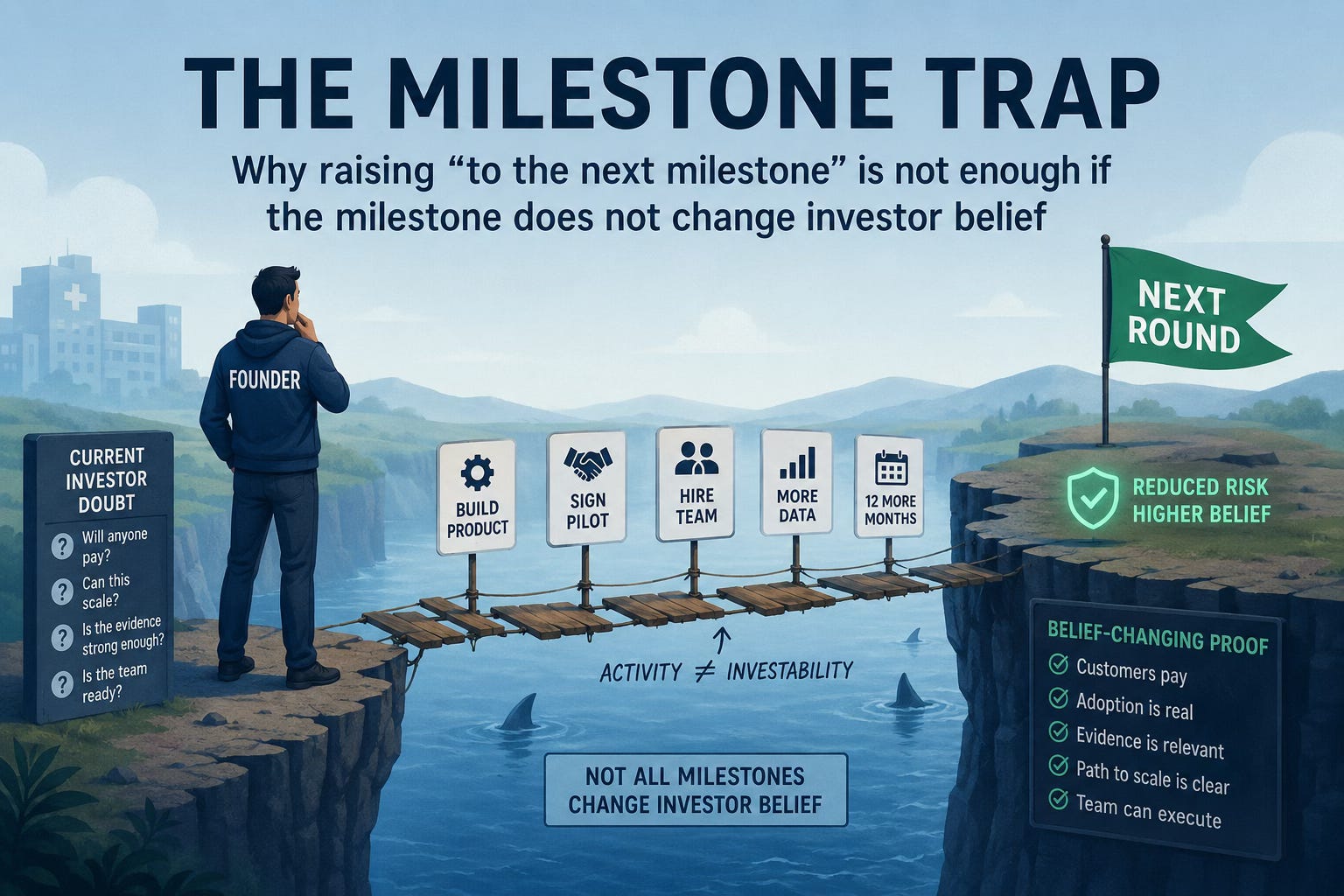
The real question is not what can we achieve. It is what belief needs to change.
Before a founder designs a fundraising plan, they need to understand what investors do not yet believe. This is where most fundraising plans are too shallow. A founder looks at their runway and works backwards. They decide how much money they need for eighteen months. They list what they can accomplish during that period. Then they call those items milestones.
That is not enough. The better question is this: at the end of this round, what must be true for the next investor to believe this company deserves to be financed at a higher price? That question changes everything because it forces the founder to connect capital to belief, not just capital to activity.
If the current objection is technical risk, then the milestone needs to prove the technology works in the relevant setting. If the current objection is clinical risk, then the milestone needs to produce evidence that matters to clinicians, patients, payers, regulators, or strategic buyers. If the current objection is adoption risk, then the milestone needs to prove that the customer can move from interest to implementation. If the current objection is commercial risk, then the milestone needs to prove that someone will pay, renew, expand, or integrate the product into a real workflow.
This is especially important for founders building in healthtech, biotech, diagnostics, medtech, digital health, and computational biology. In these markets, investors are rarely looking for generic progress. They are trying to understand which specific risk is being reduced and whether that risk reduction is strong enough to support the next financing event. A founder who understands this can build a much sharper round.
Instead of saying, “We are raising €2 million to reach our next milestone,” they can say, “We are raising €2 million to remove the three objections that currently prevent institutional Seed investors from leading the next round.” That is a very different conversation. It tells the investor that the founder understands the financing logic of the business, not just the operating plan.
Bad milestones create false confidence
The most dangerous milestones are the ones that look impressive but do not actually change the financing risk. This is why early traction can be misleading. Founders often assume that anything positive will help the next round. More users, more pilots, more meetings, more inbound interest, more partnerships, more conference invitations, and more logos on a slide can all create the feeling of momentum. But investors are not looking for a collection of positive signals. They are looking for a clean answer to the risk they still see.
A hospital pilot may look good in a deck, but if there is no budget owner, it may not prove commercial demand. A letter of intent may sound exciting, but if it is non-binding and not attached to a buying process, it may not prove willingness to pay. A pharma conversation may feel validating, but if it is exploratory and not tied to a defined business development mandate, it may not prove strategic value. A growing user base may look promising, but if usage is shallow, retention is unclear, and the buyer is different from the user, it may not prove adoption.
This is the painful part for founders. A milestone can be real and still not be fundable. It can show activity without proving urgency. It can show progress without reducing doubt. It can show momentum without answering the question that matters most. That is why founders need to be brutally honest before they raise. They need to ask whether each milestone will actually make the next investor more confident, or whether it simply gives the company another slide to show.
Healthtech founders often confuse evidence with relevance
In healthcare, evidence is essential, but evidence only matters if it is relevant to the decision being made. This is where many founders waste time and capital. They produce more data, more analysis, more technical validation, more user feedback, or more small studies. But they do not always ask whether that evidence maps to the next financing decision.
Not all evidence carries the same weight. A clinician quote is not the same as workflow adoption. A pilot is not the same as procurement approval. A technical benchmark is not the same as regulatory readiness. A patient survey is not the same as reimbursement logic. A small dataset is not the same as investable proof. A partnership announcement is not the same as commercial pull.
This does not mean those things are useless. It means they need to be understood in context. If a founder is building a clinical workflow tool, investor belief may not change simply because clinicians like the product. The real question may be whether the product saves time, reduces cost, improves outcomes, integrates into existing systems, and has a buyer who is willing to pay for those improvements.
If a founder is building a diagnostic company, investor belief may not change simply because the test works in a controlled setting. The real question may be whether the test has a clear use case, a clear clinical decision point, a reimbursement path, and a market large enough to justify venture capital. If a founder is building a drug discovery platform, investor belief may not change simply because the platform produces interesting targets. The real question may be whether the platform can generate assets, partnerships, or proprietary insight that creates enterprise value.
This is why the phrase “we need more evidence” is too vague. Founders need to know what kind of evidence matters, who it matters to, and what belief it is supposed to change.
The next round is not unlocked by time. It is unlocked by risk reduction.
Many founders still think in time-based fundraising cycles. They raise eighteen months of runway. They assume that if they execute for twelve to fifteen months, they will be ready to raise again. They build their plan around survival until the next round.
But the market does not reward survival by itself. The next round is not unlocked because eighteen months have passed. It is not unlocked because the company is still alive. It is not unlocked because the team worked hard, shipped features, attended conferences, and had promising conversations. The next round is unlocked when the company has reduced enough risk for a new investor to believe the opportunity is now more valuable than it was before.
That sounds obvious, but many fundraising plans are not built that way. They are built around burn, headcount, product timelines, and what the founder hopes to achieve. They are not built around what the next investor needs to believe. This is why some companies end up in the fundraising dead zone. They are too advanced to look like a fresh Seed investment, but not proven enough to attract a strong Series A.
The company is no longer early enough to be underwritten on potential, but it is not yet mature enough to be underwritten on proof. That is one of the most dangerous places a founder can be.
A good milestone should make the next round easier to explain
One of the simplest tests for a financing milestone is this: will this make the next round easier to explain? If the answer is no, it may not be the right milestone. A strong financing milestone gives the next investor a clearer story. It makes the company easier to underwrite. It makes the risk feel smaller, the opportunity feel larger, or the timing feel more urgent.
It should allow the founder to say, “Last round, investors were unsure whether hospitals would pay. Since then, we converted three pilots into paid contracts, identified the budget holder, shortened implementation time to eight weeks, and showed expansion demand in two accounts.” That is a real financing milestone because it changes the quality of the conversation. The founder is no longer asking investors to believe that hospitals might pay one day. The founder is showing that payment, budget ownership, implementation, and expansion are beginning to become visible.
Or the founder might say, “Last round, investors were unsure whether the science could translate into a credible development path. Since then, we generated the data required to support the next study design, validated the mechanism with external advisors, and clarified the regulatory path.” That is also a real financing milestone because it reduces uncertainty around the development plan. It gives the investor something more concrete to underwrite.
The key is not that the company did more things. The key is that the company answered the right question. A good milestone should create a before-and-after story. Before, investors were unsure about this risk. Now, the company has evidence that changes the risk. Therefore, the company deserves to be considered differently.
The use of funds slide is usually where the problem shows up
You can often see the milestone trap inside the use of funds slide. A founder will show a simple breakdown across product, team, commercial, regulatory, operations, and runway. There is nothing wrong with that as a financial overview, but it does not explain why the round matters.
Investors do not only want to know where the money will be spent. They want to know what the money will prove. Spending thirty percent of the round on product does not tell the investor why the product work changes the business. Spending twenty percent on commercial does not tell the investor whether the company will learn how the customer buys. Spending capital on regulatory does not tell the investor whether the company will reduce regulatory uncertainty enough to support the next stage.
This is why founders should rewrite their use of funds slide around proof, not categories. Instead of saying, “We will spend capital on product, commercial, regulatory, and team,” the founder should be able to say, “This round is designed to prove three things that matter for the next financing.” That is a stronger framing because it tells the investor the founder understands the connection between capital, execution, and risk reduction.
The best founders design their round around the next investor’s doubt
The strongest founders do not just ask how much money they need. They ask what doubt this money must remove. That question leads to a better fundraising strategy because it forces the company to choose the work that matters most, not just the work that feels urgent.
If a founder knows the next institutional investor will care most about commercial repeatability, they should not spend the round chasing vague partnerships. They should design the round around proving a repeatable sales motion in one defined market. If a founder knows the next investor will care most about regulatory clarity, they should not spend the round adding product features that do not change the regulatory story. They should design the round around reaching the point where regulatory risk becomes easier to price.
This is how founders move from activity to strategy. It is also how they avoid raising too little, raising too much, or raising for the wrong plan. A round should not just buy time. It should buy a change in the company’s investability. That is the real purpose of capital.
The real lesson
The next milestone is not the next thing you can achieve. It is the next thing you must prove. That is the shift founders need to make.
In a stronger market, some companies could raise on momentum, brand, narrative, and excitement. In this market, especially in healthcare and life sciences, the bar is higher. Investors want to understand exactly what risk has been reduced and why that reduction changes the financing case.
This does not mean founders need to have everything solved. Early-stage companies are supposed to be incomplete. But they do need to show that each round of capital is moving the company through a clear sequence of belief-changing proof. The founders who understand this raise better. They tell a sharper story. They use capital more intelligently. They avoid vague bridge rounds. They know what to prove before they return to market.
That is what separates progress from investability. A company can move forward and still not become more fundable. The job of a milestone is to make sure that does not happen.
P.S. Don’t forget to check out the HealthVC on YouTube and The Terminology of Venture Capital on Amazon.