
The Overbuilt Startup
Why more products can make a health company harder to fund

Dear Readers,
Welcome to the latest edition of the HealthVC newsletter.
HealthVC is the go-to newsletter for founders, LPs, and emerging managers who want to master fundraising, build institutional-grade data rooms, and understand how investors actually make decisions.
One of the easiest mistakes for a founder to justify is building more product. It feels productive. It feels strategic. It feels like progress. A new dashboard gets added. A new module gets scoped. A new workflow gets supported. A new AI layer gets introduced. A new service wrapper is built around the product. Another feature is added because a clinician mentioned it, an advisor suggested it, a pilot customer asked for it, or the founder believes it will make the company look more complete.
From the inside, this can feel like the company is becoming stronger. The product looks more impressive. The demo becomes broader. The deck has more screenshots. The platform feels more substantial. The founder can point to more capability, more functionality, and more use cases. It becomes easier to say the company is building something big.
But investors often see something different.
They do not automatically treat more product as more progress. In many cases, more products make the company harder to understand, harder to underwrite, and harder to believe. Not because product development is bad, but because too much product too early can hide the fact that the founder has not yet proven which part of the business actually matters.
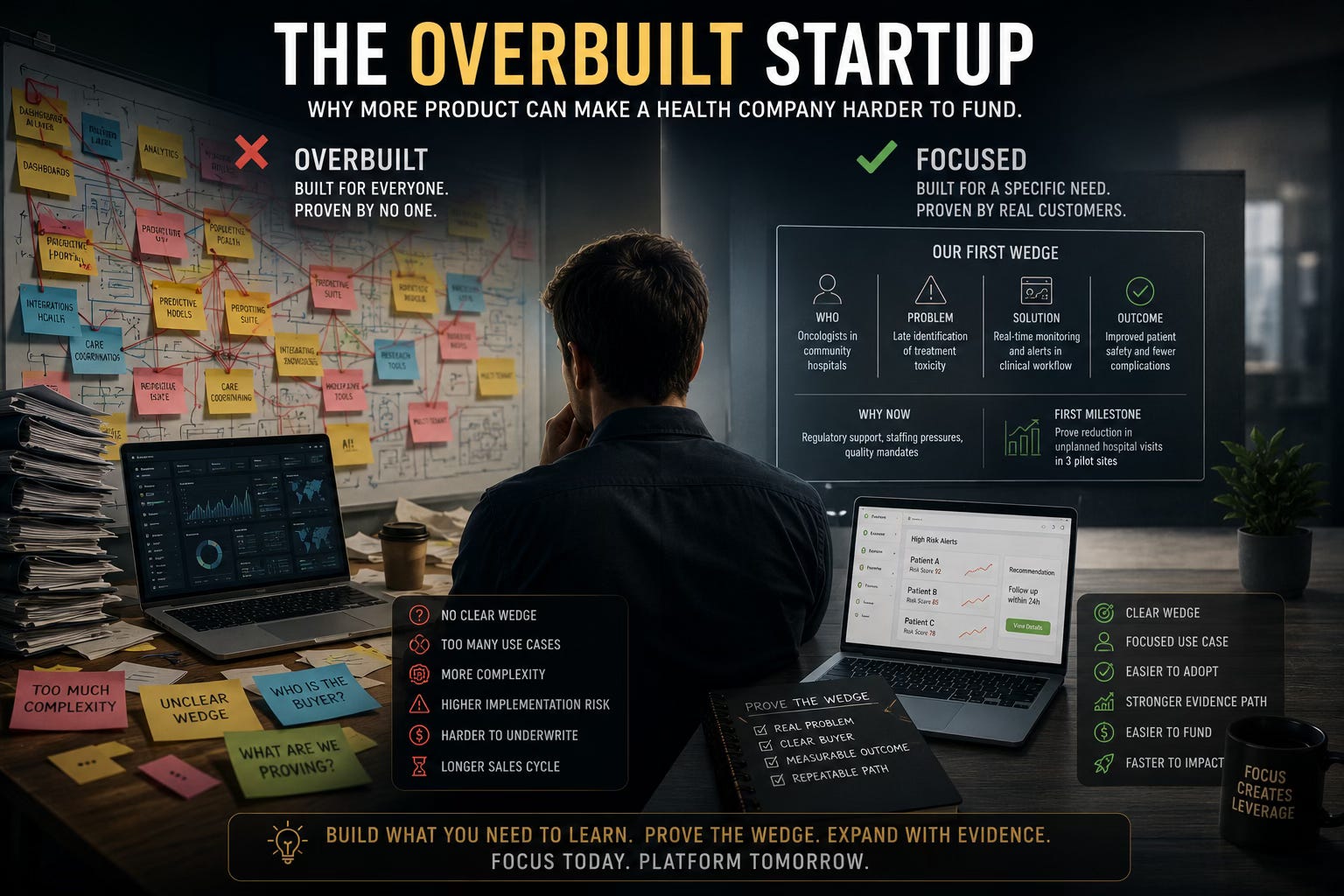
This is the overbuilt startup problem. It happens when founders keep building around the uncertainty instead of moving through it. They expand the product before they have proven the smallest valuable wedge. They add complexity before they have proven urgency. They build a platform before they have proven the first repeatable use case. They create more surface area before they know which part of the company customers, users, buyers, partners, or investors truly care about.
In health, this problem is especially common because the market is complex and the feedback is noisy. Clinicians want one thing. Hospitals want another. Patients need something else. Payers ask different questions. Investors focus on fundability. Advisors suggest future use cases. Strategic partners talk about optionality. The founder tries to respond to all of it by building more.
But building more is not always the same as learning more.
And when a startup becomes overbuilt before it becomes understood, the product can start to work against the fundraising story.
More products can hide less clarity
The first danger of an overbuilt startup is that more product can hide less clarity. A founder may have many features, but still not know the first buyer. They may have a broad platform, but still not know the first market. They may have a polished dashboard, but still not know which decision it improves. They may have multiple use cases, but still not know which one creates urgency. They may have a product that can do many things, but not enough evidence that any one thing is valuable enough to drive adoption.
This is where investors become cautious. A large product surface area can look impressive at first, but it can also raise questions about focus. Why has the company built so much before proving the core use case? Which part of the product is actually driving demand? Which feature creates measurable value? Which user depends on it? Which buyer cares enough to pay? Which workflow is painful enough to change? Which part of the product would customers miss if it disappeared tomorrow?
Founders often assume that a broader product makes the company look more mature. Sometimes it does, especially if the company has already proven demand and is expanding from a strong base. But at the early stage, breadth can create doubt. It can make investors wonder whether the founder is building because the market has pulled the company forward or because the company is still searching for what matters.
The difference is important. A startup that expands after proving a wedge is scaling from insight. A startup that expands before proving a wedge may be avoiding the hard work of focus.
Investors are not trying to punish founders for building. They are trying to understand what the product has proven. If the answer is unclear, more product does not solve the problem. It often makes the problem harder to see.
Founders often build to avoid learning
Building feels safer than learning because building is controllable. A founder can open the product roadmap, define a new feature, assign tasks, brief engineers, update designs, and show visible progress. Learning is more uncomfortable. It requires exposing the company to the market. It requires asking whether customers care, whether buyers will pay, whether the use case is urgent, whether the workflow fits, whether the product removes enough pain, and whether the company is solving something that matters now.
Many founders do not avoid learning consciously. They genuinely believe they are improving the company. But product work can become a refuge from commercial truth. It is easier to build another module than to hear that the buyer is unclear. It is easier to improve the dashboard than to test whether anyone will pay for it. It is easier to add AI than to prove the workflow problem. It is easier to expand the platform than to choose a narrow use case and accept that the rest can wait.
This is especially true in health because customer discovery can be slow and ambiguous. A clinician may like the product but not be the buyer. A hospital may explore a pilot but not have a budget. A pharma team may say the platform is interesting but not have a defined use case. A patient group may validate the need but not the business model. These signals create uncertainty, and building can make the founder feel like they are still moving forward while the market remains unresolved.
Investors notice when product development is being used as a substitute for market clarity. They hear it when the founder talks in features instead of evidence. They see it when the roadmap is more detailed than the customer strategy. They feel it when the demo is impressive, but the adoption path is vague. They become concerned when the company has built a lot but still cannot answer the basic questions of who needs it most, why they need it now, and what they will do differently because it exists.
The best founders do not build to avoid learning. They build to test what they have learned.
The platform temptation
The word platform is one of the most dangerous words in early-stage health fundraising. It can be powerful when it is earned, but dangerous when it arrives too early. Founders like platforms because they suggest scale, optionality, and ambition. A platform can serve multiple use cases, multiple stakeholders, multiple conditions, multiple markets, and multiple revenue streams. It makes the company sound bigger than a point solution.
The problem is that investors often hear platform and immediately ask what has been proven first.
A platform without a wedge is hard to fund because the investor does not know what to believe. Is the company a clinical workflow tool, a diagnostic engine, a data infrastructure company, a patient engagement product, a provider solution, a pharma partnership platform, an AI decision support system, or a services-enabled technology business? The founder may believe the answer is all of the above, but early investors usually need the answer to be much sharper.
This does not mean platform ambition is wrong. Some of the most valuable health companies become platforms over time. But they rarely start by asking the market to believe the full platform at once. They begin with a painful use case, a specific user, a clear buyer, a narrow workflow, a defined evidence path, or a focused commercial wedge. Once that wedge works, the platform becomes more credible because it is expanding from proof rather than possibility.
A platform should be the result of repeated value, not a way to avoid choosing where value begins.
This is where founders need discipline. They can still explain the long-term platform vision, but the fundraising story needs to make the first wedge obvious. Investors should understand what the company is proving now, why that first use case matters, and how it creates the right to expand later.
Without that sequence, the platform story can feel like a product trying to be everything before it has proven anything.
Feature requests are not strategy
Another reason startups become overbuilt is that founders confuse feature requests with market strategy. This is common in health because every stakeholder sees the product through their own workflow, incentives, and frustrations. A clinician asks for a different view. A hospital contact asks for another integration. An advisor suggests an additional use case. A pilot customer wants a specific reporting layer. A strategic partner asks whether the product could also support something adjacent.
Some of these requests may be valuable. Some may reveal real adoption barriers. Some may point toward a stronger wedge. But many are simply context-specific preferences. They reflect one user, one institution, one workflow, one stakeholder, or one hypothetical future customer. If the founder treats every request as strategic, the product becomes a collection of other people’s opinions.
That is dangerous because every feature has a cost. It adds engineering time, design complexity, implementation burden, support requirements, onboarding friction, and narrative complexity. It also makes the company harder to explain. The more the product tries to do, the harder it becomes to identify what is essential.
Investors are not impressed by a roadmap that responds to every external suggestion. They want to see that the founder can separate signal from noise. A feature request should not automatically become product direction. The founder needs to ask what the request proves. Is this a one-off preference or a repeated pattern? Does it reduce adoption friction or add complexity? Does it strengthen the first wedge or distract from it? Does the buyer care? Does it support the next milestone? Would the customer pay more because of it? Would the product fail without it?
The strongest founders do not ignore customers, clinicians, advisors, or partners. They listen carefully. But they do not let every voice shape the product equally. They understand that product discipline is part of company discipline.
Overbuilding can weaken the fundraising story
A fundraising story needs to be clear enough for investors to carry. This is not only about the deck. It is about whether the investor can explain the company to partners, advisors, investment committees, co-investors, and future stakeholders. An overbuilt product often makes that harder.
When a company has too many modules, markets, use cases, and claims, the investor has to work harder to understand the core business. They may like parts of the product but still struggle to know what the company really is. They may see interesting technology but not a clean wedge. They may respect the founder’s work but worry that the business has not yet found focus.
This matters because investors are not just funding effort. They are funding a path to value. More product does not automatically make that path clearer. In fact, it can blur the path if the product has expanded faster than the evidence.
A founder may say the company serves hospitals, patients, payers, pharma, providers, and researchers. That might sound large, but it also suggests multiple buyers, multiple sales motions, multiple evidence requirements, multiple pricing models, and multiple adoption pathways. A founder may say the product combines AI, workflow software, analytics, patient engagement, clinical decision support, and services. That might sound sophisticated, but investors will ask which part drives the business.
The risk is that the company starts to look like a solution searching for its market rather than a company built around a clear market need.
The best fundraising stories usually have a strong centre. The investor understands the problem, the first customer, the wedge, the evidence, the milestone, and the reason capital matters now. The product can be ambitious, but the story has to be focused.
The smallest valuable wedge
The alternative to overbuilding is not underbuilding. It is finding the smallest valuable wedge. This is the narrow part of the product and market where the company can prove something meaningful. It is not necessarily the smallest feature, and it is not necessarily the smallest market. It is the smallest focused use case that can demonstrate real value, reduce a real risk, and create a credible path to expansion.
For a health company, the smallest valuable wedge might be one clinical workflow, one patient population, one provider segment, one decision point, one diagnostic use case, one therapeutic indication, one administrative pain point, one buyer group, or one measurable outcome. The key is that the wedge must matter. It should not be narrow for the sake of being narrow. It should be narrow because focus creates proof.
A good wedge helps the founder answer important questions. Who has the pain? Why does it matter now? What does the product change? Who needs to use it? Who needs to approve it? What evidence proves it works? What would make the customer continue, expand, pay, or partner? What does success in this wedge unlock next?
This is what makes a company easier to fund. Investors can understand what the current round is designed to prove. They can see how capital turns into evidence. They can understand why the wedge matters and how it could lead to a broader platform over time.
A founder who says, “We are building a platform for the entire market,” asks investors to believe a lot at once. A founder who says, “This is the first wedge, this is why it matters, this is what we have learned, this is what the next round proves, and this is how it expands,” gives investors a sequence of belief.
That is the difference.
More products can create more implementation risk
In health, more product does not only create more internal complexity. It can also create more implementation risk for the customer. Every additional feature, workflow, integration, dashboard, data field, reporting layer, user type, and service component can make the product harder to adopt.
Founders often think more functionality makes the product more valuable. Buyers may see more work. A hospital may ask who will train staff, who will manage the integration, who will maintain the workflow, who will interpret the data, who will change behaviour, who will be responsible if the product is not used properly, and who will measure success. A product that looks powerful in a demo may feel heavy in a real operating environment.
This is why overbuilt products can struggle in healthcare. The product may solve several problems, but if it requires too much change, the customer may delay adoption. The company may believe it has created more value, while the buyer sees more operational burden.
Investors understand this. They know healthcare systems are already under pressure. They know staff are overloaded, budgets are constrained, and procurement is slow. They know that adoption depends not only on whether a product is useful, but whether the organisation can absorb it.
A focused product with a clear use case can sometimes be easier to adopt than a broad product with many capabilities. It creates less confusion, less training burden, less implementation friction, and clearer success criteria. That does not mean the company must remain narrow forever. It means the first adoption path should be as clean as possible.
In health, a product that is easier to adopt is often easier to fund.