

Dear Readers,
Welcome to the latest edition of the HealthVC newsletter.
HealthVC is the go-to newsletter for founders, LPs, and emerging managers who want to master fundraising, build institutional-grade data rooms, and understand how investors actually make decisions.
Most founders think diligence happens in the obvious places.
The pitch meeting. The follow-up call. The data room. The financial model. The customer references the founder provides. The investor update. The partner meeting. The formal diligence process after a fund becomes serious.
All of that matters, but it is not the whole picture.
Investors do not only diligence the company through the materials the founder controls. They also diligence the company through the market. They speak to customers, former colleagues, advisors, operators, co-investors, sector experts, clinicians, executives, academics, founders, recruiters, strategic partners, and people who have seen the company from different angles.
Sometimes the founder knows those calls are happening. Sometimes they do not.
This is the reference call risk. It happens when the market is telling a story about the company before the founder realises diligence has already started. That story may reinforce the investment case. It may create doubt. It may explain why customers care. It may reveal that the product is harder to implement than the founder suggested. It may validate the founder’s reputation. It may surface concerns about execution, leadership, commercial maturity, science, adoption, or team quality.
Founders often underestimate this because they think diligence is linear. First meeting, second meeting, data room, formal references, investment committee. In reality, investor diligence is often happening around the process, not only inside it.
A fund may speak to someone who knows the buyer. A partner may message an operator in the space. An associate may call another founder who has sold into the same customer segment. A venture partner may know someone who worked with the founder before. A co-investor may have heard the company discussed in another round. A strategic may have seen the product in a pilot. A customer may have told someone the company is impressive, but not yet ready.
The market talks.
The question is whether the story it tells supports the story the founder is telling.
Diligence does not wait for permission
Founders often assume that serious diligence begins only when an investor formally asks for references. That is not how many investors work. By the time a founder receives a detailed diligence request, the investor may already have spoken to several people around the market.
This is not always a bad thing. A strong market reputation can help the company. If customers speak highly of the product, if operators respect the founder, if former colleagues describe the founder as exceptional, if sector experts confirm the pain is real, and if other investors say the company has been thoughtful, the founder benefits from a story they did not have to push.
But the reverse is also true. If the informal market narrative is messy, investors may slow down before the founder understands why. They may ask more cautious questions. They may become harder to read. They may say they need more time. They may pass with polite language because the concern came from a conversation the founder never saw.
This is uncomfortable because founders like to believe they control the fundraising process. They control the deck. They control the narrative. They control the data room. They control which customer references are provided. They control the update cadence. They control what gets shared and when.
Informal diligence breaks that illusion.
Investors are trying to reduce uncertainty. If they can learn more about the company from people around the market, they will. That does not mean they are acting unfairly. It means they are doing their job. Early-stage investing often involves incomplete information, and investors use networks to test whether the founder’s version of reality matches what others are seeing.
The founder cannot control every reference call. But they can understand that the company is always creating references, whether intentional or not.
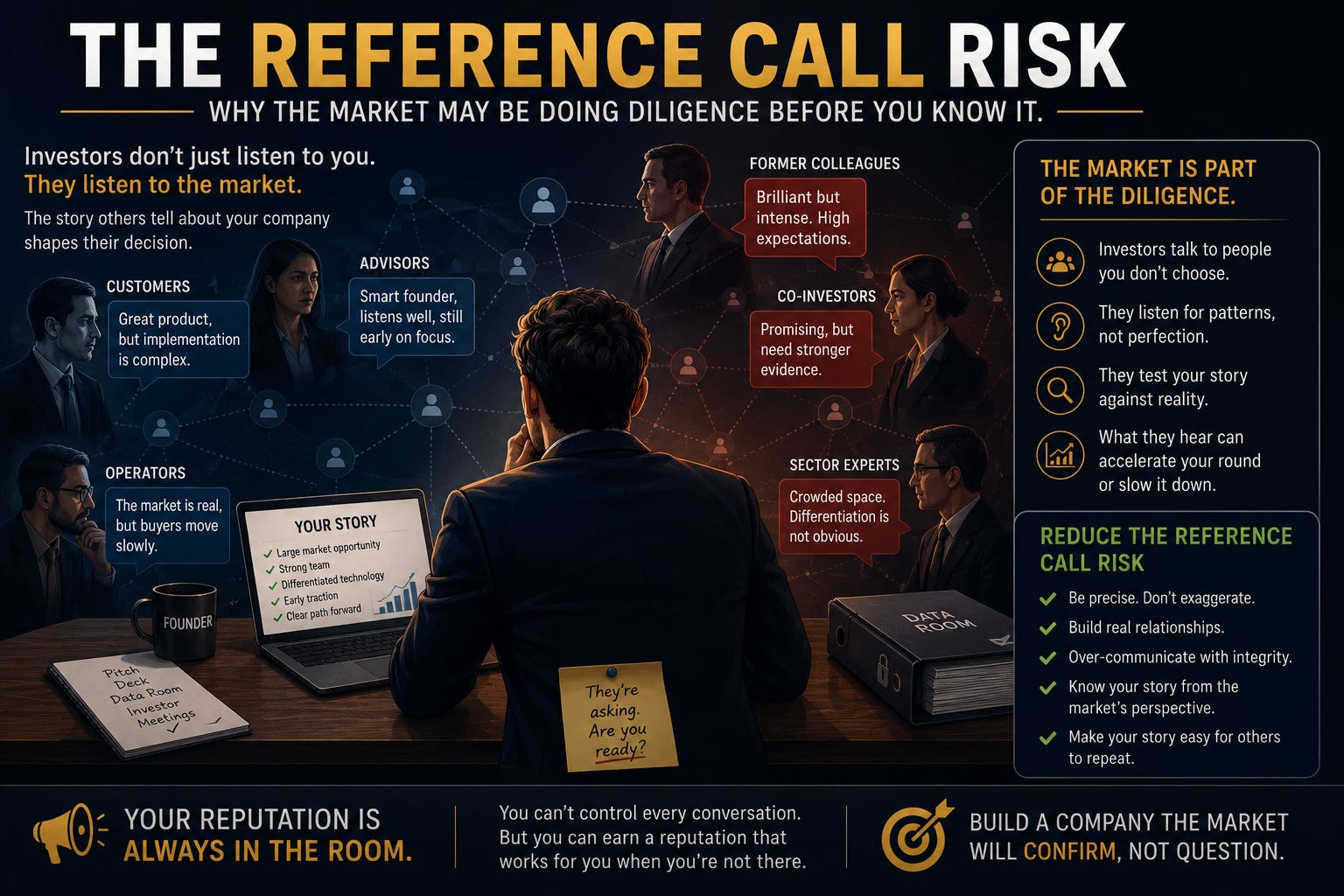
Your reputation is part of the data room
A data room contains documents. The market contains memory.
Founders often spend weeks polishing materials while ignoring the fact that many important people already have an opinion about the company. Customers remember how the team handled implementation. Advisors remember whether the founder listened or only collected names. Former employees remember whether the company was clear or chaotic. Co-investors remember whether updates were consistent. Operators remember whether the product solved a real problem or only sounded good in a pitch.
That memory becomes part of diligence.
This is why reputation is not a soft issue. It is not separate from the financing process. It influences investor trust, customer confidence, hiring, partnerships, and the willingness of others to help the company. A founder with a strong reputation can often move faster because the market gives them credibility before the meeting starts. A founder with a weak or unclear reputation may have to work harder because every claim needs more proof.
In health, this matters even more because the market is smaller than founders think. Specialists know each other. Clinicians speak to other clinicians. Investors compare notes. Strategic teams watch companies for years. People move between hospitals, pharma, venture funds, startups, universities, and advisory roles. A conversation in one corner of the market can reach another corner quickly.
That does not mean founders need to be paranoid. It means they need to be consistent. The story told in the deck should not be completely different from the story customers experience. The founder’s description of traction should not be dramatically stronger than what references would say. The partnership slide should not imply commitment where there is only exploration. The market access story should not depend on names that would not confirm the relationship.
When the external story and the market story diverge, diligence becomes harder.
Informal references test exaggeration
One of the reasons investors make reference calls is to test whether the founder is exaggerating. This does not always mean lying. More often, the concern is inflation.
A founder may call a customer conversation “traction.” The customer may describe it as early exploration. A founder may describe a pilot as highly engaged. The hospital may say the pilot is interesting, but not a priority. A founder may describe a strategic partner as excited. The corporate team may say they are watching the space but not moving yet. A founder may describe an advisor as deeply involved. The advisor may say they have only had two calls.
None of these gaps have to destroy the round, but they create doubt.
Investors understand that founders are optimistic. They expect some ambition in the story. But they become concerned when the founder’s version of reality is consistently ahead of what the market confirms. That gap makes the investor wonder what else may be overstated.
This is why precision matters. Founders should describe relationships, evidence, customer demand, pilots, partnerships, and investor interest accurately. It is better to say, “We are in early discussions with two hospital innovation teams,” than to imply those hospitals are already committed customers. It is better to say, “We have a clinical advisor who has helped us refine the use case,” than to imply that advisor is actively opening commercial doors if they are not.
Precision builds trust because it survives reference calls.
The strongest founders do not need to inflate. They understand that investors will check. They know that a clean, honest description of progress is more valuable than an impressive claim that becomes weaker once the market is contacted.
References reveal how the company behaves
Formal diligence often tests what the company has done. Informal references often reveal how the company behaves.
This matters because early-stage companies are not fully formed. Investors are not only evaluating assets, but patterns. They want to understand how the founder handles pressure, feedback, complexity, and relationships. They want to know whether the company learns quickly, communicates clearly, follows through, and earns trust over time.
A customer reference may reveal whether the company understands workflow reality. An advisor reference may reveal whether the founder can filter advice. A former colleague may reveal whether the founder is resilient, difficult, disciplined, chaotic, or unusually effective. A co-investor may reveal whether the founder communicates well when things are not going perfectly. An operator may reveal whether the product is credible or fragile. A sector expert may reveal whether the market need is urgent or only academically interesting.
These signals are powerful because they come from outside the founder’s controlled narrative.
Investors know every founder is selling during fundraising. That is expected. The purpose of references is to understand what remains true when the founder is not pitching. Does the company still sound compelling when described by someone else? Does the founder’s reputation support the level of trust required? Do customers describe real pain? Do people who know the space agree that the wedge makes sense? Do people around the company believe the founder can execute?
The market does not need to be universally positive. No company is liked by everyone. But the pattern matters. One cautious comment may not mean much. Repeated concerns across several calls are different.
Investors listen for patterns.
The references you do not choose may matter most
Founders usually prepare formal references carefully. They select the customer who loves the product, the advisor who is supportive, the investor who believes in the company, and the operator who understands the market. Those references can help, but investors know they are selected.
The more revealing references are often the ones the founder does not choose.
Investors may speak to a customer who did not convert. They may speak to someone who used to advise the company. They may speak to a former employee. They may speak to an investor who passed. They may speak to a buyer in the same category who has not heard of the company. They may speak to a competitor’s customer. They may speak to someone who understands the workflow, reimbursement, regulatory, or procurement challenge better than the founder expects.
These conversations can be valuable because they provide texture. They help investors understand whether the company’s challenge is normal, serious, hidden, or misunderstood. A lost customer may still validate the pain. A passed investor may still respect the founder. A cautious operator may still confirm the market is moving. A former advisor may still say the founder is excellent, but early.
The danger is not that every reference must be perfect. The danger is when the founder has not thought about what unselected references might say.
If the founder knows why a customer did not convert, they can explain it. If they know why an investor passed, they can interpret the signal. If they know why a pilot stalled, they can show what was learned. If they know where the market is sceptical, they can address it directly.
Founders lose control when they are surprised by the market’s own version of the company.
The market can validate what the deck cannot
Reference calls are not only a risk. They can also be one of the strongest assets in a fundraising process.
A deck can explain that the problem is urgent. A customer can confirm that it is urgent. A data room can show early usage. A buyer can explain why the workflow matters. A founder can describe the market gap. A sector expert can confirm that the gap is real. A company can claim that implementation is manageable. An operator can explain why the team has made the right tradeoffs.
This is powerful because investors trust independent confirmation. They know the founder has an incentive to make the company sound attractive. When people around the market confirm the same story, the investor’s confidence increases.
The strongest fundraising processes often have this kind of external reinforcement. The investor hears the founder’s story, then hears similar language from customers, advisors, operators, or sector experts. The same themes repeat. The pain is real. The founder is credible. The product is relevant. The team listens. The use case is clear. The market is early but moving. The risk is understood. The next milestone makes sense.
That consistency creates conviction.
This is why founders should think of references as part of company building, not only fundraising. Every customer conversation, advisor interaction, pilot, investor update, and partnership discussion is shaping what the market might say later. A founder who communicates clearly and behaves consistently creates a stronger informal diligence trail.
The company’s reputation is built before the investor starts checking it.
Health makes reference calls more important
In health, informal diligence matters because the market is complex. Investors often need help understanding whether a claim is credible. A generalist investor may need to speak to clinicians, health system leaders, reimbursement experts, regulatory advisors, pharma operators, or specialist investors. Even specialist investors use references to pressure test the practical reality behind the story.
A product may look compelling in a deck, but a clinician can explain whether it fits the workflow. A market may look large, but a buyer can explain whether there is budget. A diagnostic may show promising performance, but an expert can explain whether the evidence package is sufficient. A digital health product may claim ROI, but an operator can explain whether implementation would slow adoption. A therapeutic platform may look exciting, but a specialist can explain whether the translational logic is strong enough.
This is not a weakness of health investing. It is the nature of the sector.
Health companies sit inside systems that are regulated, budget-constrained, evidence-driven, politically complex, and slow to change. No investor can understand every piece from the deck alone. Reference calls help investors understand the reality around the company.
This is also why founder credibility matters so much. Investors know that health founders must navigate stakeholders who do not all think the same way. Clinicians, buyers, regulators, payers, pharma teams, patients, investors, and strategic partners may each see a different risk. A founder who earns trust across those groups becomes more backable. A founder who creates confusion across those groups becomes harder to underwrite.
In health, the market does not only validate the product. It validates the founder’s ability to navigate the system.
Your narrative has to travel without you
One of the most important tests in fundraising is whether the company’s story can travel without the founder in the room. Reference calls are one way investors test this.
When an investor speaks to someone around the market, they are not only asking, “Is this company good?” They are also asking, “Does the company mean the same thing to others as it means to the founder?”
If the founder says the company solves an urgent workflow problem, do customers describe the same urgency? If the founder says the product reduces burden, do users describe that value clearly? If the founder says a partnership is strategic, does the partner see it that way? If the founder says the next milestone matters, do experts agree that it changes the risk profile?
When the story travels cleanly, the investor gains confidence. When the story changes too much depending on who is speaking, the investor may worry that the company is not yet clear enough.
This is why founders need to make the company easy for others to describe. Customers should be able to explain the value. Advisors should be able to explain where the company fits. Existing investors should be able to explain the next milestone. Team members should be able to explain the wedge. Strategic partners should be able to explain why the company matters to them.
The founder does not need everyone to use the same words. But the meaning should be consistent.
A company becomes more investable when the market can repeat its logic.
How to prepare for informal diligence
The deeper question is not how to control every reference call. You cannot. The better question is how to build a company whose market story can survive diligence.
