
The Unfundable Complexity Problem
Why investors struggle when too many things need to become true at the same time

Dear Readers,
Welcome to the latest edition of the HealthVC newsletter.
HealthVC is the go-to newsletter for founders, LPs, and emerging managers who want to master fundraising, build institutional-grade data rooms, and understand how investors actually make decisions.
Health companies are naturally complex. That is part of the sector. A founder may need to manage science, product, clinical validation, regulation, reimbursement, procurement, market access, patient safety, data protection, stakeholder incentives, behaviour change, and long sales cycles before the company can become truly investable. Investors understand this. They do not expect health companies to look like simple software businesses, and they do not expect every risk to be removed at the earliest stage.
But there is a difference between necessary complexity and unfundable complexity.
Necessary complexity is the reality of building in health. It is the set of risks that naturally comes with the category, the product, the science, or the market. Unfundable complexity is what happens when a founder stacks too many unresolved risks on top of each other and expects investors to believe they will all be solved at the same time.
This is one of the most common reasons health companies become hard to fund. The company may be exciting. The mission may be important. The science may be promising. The product may be useful. The market may be large. But when investors look at the business, they see too many things that need to become true before the company can work.
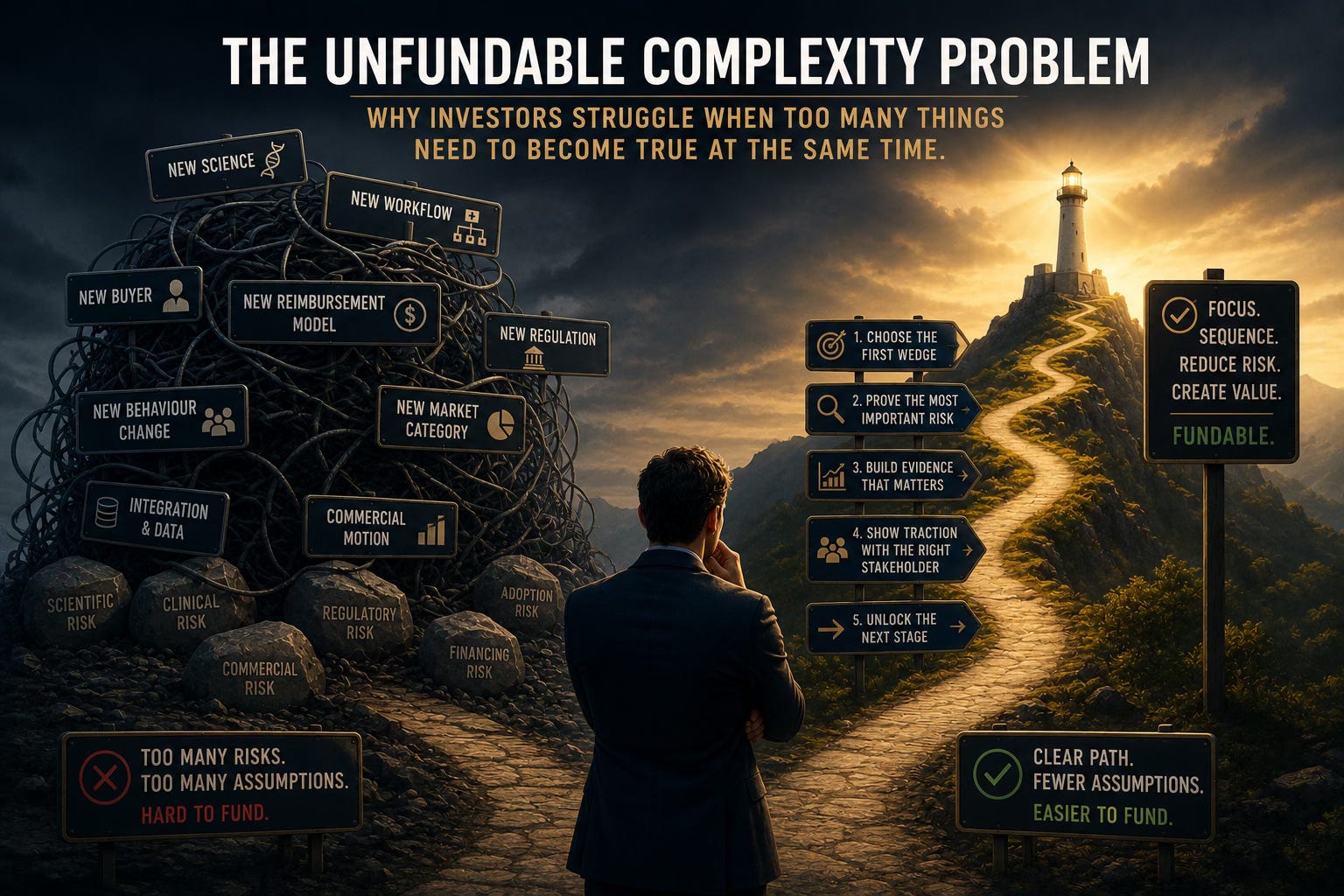
The founder is asking investors to believe in new science, a new workflow, a new buyer, a new reimbursement model, a new regulatory pathway, a new behaviour change, a new data infrastructure, a new category, and a new commercial motion, all at once. Individually, each risk may be manageable. Together, they can make the company almost impossible to underwrite.
This is the unfundable complexity problem. It is not that investors dislike ambition. It is that ambition becomes difficult to fund when the company depends on too many unproven assumptions becoming true in the right order.
Investors are not afraid of risk
A common founder's misunderstanding is that investors avoid risk. They do not. Venture capital exists because investors take risks. The entire asset class is built around uncertainty, incomplete information, and the possibility that a company may become much more valuable if the right risks are reduced over time.
The issue is not the risk itself. The issue is risk concentration.
Investors can often underwrite one major risk if they understand it clearly. They may take scientific risks if the team is exceptional and the market is meaningful. They may take commercial risk if the technology is already strong. They may take regulatory risk if the pathway is credible and the value creation potential is large. They may take adoption risk if the economic case is compelling. They may take early market risk if the category is forming and the company has a credible wedge.
What becomes difficult is when the company carries many major risks at the same time without a clear plan for reducing them. If the science is unproven, the buyer is unclear, the payment model is uncertain, the workflow is disruptive, the regulatory pathway is unresolved, and the market category still needs to be created, the investor is not evaluating one risky company. They are evaluating a chain of dependencies.
Every link in that chain has to hold.
That is where investors slow down. They are not only asking whether the opportunity is big. They are asking how many assumptions need to work before the company becomes valuable. The more assumptions that need to work at the same time, the harder the company becomes to fund.
This is why founders need to understand how investors think about risk. They do not simply count upside. They map the route between today’s uncertainty and tomorrow’s value. If that route requires too many unresolved things to go right, the company can become unfundable even when the idea is strong.
Complexity becomes dangerous when it is not sequenced
Complexity is not always a problem. Some of the best health companies are complex. They involve difficult science, regulated markets, clinical evidence, long development timelines, and sophisticated stakeholder environments. Complexity can even be an advantage if it creates defensibility. A company that solves a difficult problem may be harder to copy, more valuable to strategic partners, and more meaningful to the healthcare system.
But complexity has to be sequenced.
Sequencing means the founder understands which risks need to be reduced first, which risks can wait, which risks are connected, and which milestones will make the company more fundable. Without sequencing, the company feels like a pile of open questions. With sequencing, the same company starts to feel more investable because investors can see the path.
This is where many founders lose investors. They describe all the things the company will eventually do, but they do not explain which risk comes first. They talk about the full platform, the broad market, the future reimbursement opportunity, the international expansion, the strategic partnerships, the clinical outcomes, the regulatory route, the enterprise sales motion, and the long-term vision. The company sounds ambitious, but not staged.
Investors need staging. They need to know what this round proves. They need to know which risk is being reduced now and why that risk matters more than the others. They need to know what the company will look like after the round, what evidence will exist, what uncertainty will remain, and why the next investor, customer, partner, or acquirer will care.
A complex company becomes more fundable when the founder can turn complexity into sequence. The question is not whether everything is solved today. The question is whether the founder knows what must be solved next.
Too many new things at once
The most dangerous version of the unfundable complexity problem appears when a company is trying to introduce too many new things into the market at the same time. A new technology is hard enough. A new workflow is hard enough. A new buyer is hard enough. A new reimbursement model is hard enough. A new regulatory pathway is hard enough. A new clinical behaviour is hard enough. A new market category is hard enough.
When a company combines several of these, the adoption burden becomes much heavier.
For example, a founder may have a promising AI tool that requires hospitals to change workflow, trust a new type of clinical decision support, integrate with existing systems, create a new budget line, accept a new risk profile, and measure outcomes in a way they do not currently measure. The product may be useful, but the number of changes required from the customer is high. Investors will ask whether the market is ready to absorb that much change.
Another founder may have a diagnostic platform that needs new evidence, new clinician behaviour, payer acceptance, reimbursement clarity, lab adoption, and a new understanding of where the test fits in the care pathway. Again, the company may be important, but investors will ask whether too many stakeholders need to change before the business can scale.
A therapeutic platform may face a different version of the same problem. The science may be novel, but the company may also need to prove a new modality, choose the right first indication, build a clinical development strategy, attract strategic interest, protect IP, recruit specialised talent, and raise enough capital to reach a meaningful inflection point. Each of those risks may be normal, but together they can create a high proof burden.
This is not about discouraging innovation. Healthcare needs new science, new tools, new models, and new categories. But founders need to understand that every new thing adds friction. The more new things the company asks the market to accept, the more evidence investors need before they believe.
The market does not adopt complexity just because the problem matters
One of the most painful truths in health is that important problems do not automatically create fast adoption. A problem can be serious, expensive, frustrating, and widely recognised, and still remain unsolved for years. Healthcare systems are full of problems that everyone agrees are real. That does not mean they are easy to fix, easy to fund, or easy to sell into.
This is where founders sometimes misread the market. They assume that because the problem is obvious, the system will act. But healthcare systems do not adopt solutions simply because the problem matters. They adopt when the solution fits the incentives, workflow, budget, evidence requirements, procurement process, regulatory environment, and operational capacity of the organisation.
A founder may say the current system is broken. The investor may agree. But agreement that the system is broken is not the same as a belief that this company can change it. The investor still needs to understand who has the power to act, why they will act now, what evidence they need, how the product fits into existing behaviour, how the company gets paid, and what makes the adoption path realistic.
This is why complexity can make a company less fundable even when the mission is strong. The founder is often focused on the size of the problem. Investors are focused on the path through the system. A large problem with no clear adoption route may be less fundable than a smaller problem with a sharper path to proof.
The market does not reward founders for identifying complexity. It rewards founders who can navigate it.
Broad platforms often carry hidden complexity
Platform companies are especially vulnerable to the unfundable complexity problem. A platform can sound exciting because it suggests scale, optionality, and multiple routes to value. It may be able to support many indications, many workflows, many customer types, or many commercial models. For founders, this breadth feels like strength.
For investors, breadth can create concern if the first path is unclear.
A platform with too many possible applications can become hard to underwrite because investors do not know which proof point matters. If the company could serve hospitals, pharma, payers, researchers, employers, and patients, the founder may believe the market is large. But the investor hears multiple buyers, multiple sales motions, multiple evidence requirements, multiple budgets, and multiple adoption pathways.
That is not always strength. Sometimes it is confusion.
The strongest platform founders do not try to make investors believe everything at once. They choose a first path that proves something important about the platform. They explain why that path is the right starting point, what evidence it creates, why the market cares, and how it opens future opportunities. They make the platform feel staged rather than scattered.
This is important because optionality without sequence is not strategy. It is complexity. Investors may believe the platform could be valuable someday, but they still need to understand what the company is doing now. If the founder cannot explain the first wedge clearly, the platform can feel more like a research direction than an investable company.
The proof burden rises with every assumption
Every health company has a proof burden. The proof burden is the level of evidence investors need before they believe the company can move forward. That burden depends on the category, the claim, the customer, the risk, and the stage of the company.
A company making a low-risk workflow improvement may need to prove usability, adoption, time savings, and budget relevance. A company making clinical outcome claims needs stronger evidence. A diagnostic company needs to show analytical and clinical relevance, and often a path to payment. A regulated device company needs to show safety, performance, regulatory logic, and adoption potential. A therapeutic company may need to generate deep scientific, preclinical, clinical, and strategic evidence over time.
The proof burden rises when the company adds more assumptions. If the founder is asking investors to believe in a new technology and a new buyer, the proof burden rises. If the company also requires a new workflow, the burden rises again. If the company depends on a new reimbursement model, it rises again. If the company is trying to create a new category, it rises again.
This is why founders should be careful with ambitious claims. Every claim creates a proof requirement. If the company claims better outcomes, investors will ask for evidence. If it claims cost savings, investors will ask who saves money and whether the savings are measurable. If it claims workflow efficiency, investors will ask whether the workflow has been tested. If it claims strategic value, investors will ask who would care and why.
A founder may think they are making the company more attractive by expanding the ambition. But if the ambition adds too many proof requirements, it can make the company harder to fund.
Focus is not a lack of ambition
Some founders resist focus because they worry it makes the company look smaller. They want investors to see the full vision. They want to show all the markets, all the use cases, all the future partnerships, all the possible products, and all the ways the company could grow. That instinct is understandable, especially when founders are trying to raise venture capital and need to show scale.
But focus is not the enemy of ambition. Focus is how ambition becomes fundable.
A focused company is not saying the future is small. It is saying the first path is clear. It is showing investors where the company begins, what it proves, and how that proof unlocks the next stage. It reduces the number of assumptions investors need to believe immediately and gives the company a more credible way to create value.
This is especially important in health because broad ambition without a narrow entry point can make the company look naive. Investors know that healthcare systems do not move easily. They know that adoption is slow, evidence matters, stakeholders are fragmented, and budgets are difficult. When a founder claims the company can transform a large part of the system without explaining the first narrow path, investors become cautious.
The strongest founders can show both ambition and discipline. They can explain the big vision, but they do not ask investors to fund the entire vision at once. They show the first risk to reduce, the first stakeholder to win, the first evidence to create, and the first value inflection to reach.
That is what makes complexity investable.